My mother's great grandfather, Michael Steele, married a woman named Charlotte Stradley, the daughter of a man who described himself as a "physician" in the 1850 census for Wabash, Indiana. That would be my great great great grandfather, Dr. Daniel W. Stradley. His grandfather came to America from England around the time of the Revolution and settled in Baltimore. Charlotte Stradley is the first ancestor I know of who was not either of German or Pennsylvania Dutch descent.
I recently located biographical records for her brothers, Dr. Ayres Stradley and Dr. Daniel N. Stradley, who both practiced medicine in and around Denver, Colorado at the dawn of the 20th century. The brothers attributed much of their expertise in medicine to training they had received from their father while growing up in Wabash. But they also cited lectures they had attended at established medical schools and apprenticeships they had served under the tutelage of other respected medical practitioners.
I try to imagine the frontier medicine practiced by this ancestor of mine, first in Zanesville, Ohio and then at age 35 in Wabash from 1849 on, where he spent the last forty-five years of his life, but I find it's quite a leap. Medical science made huge strides in his lifetime.
Born in 1815, it's not clear from his sons' accounts if he began life on the eastern seaboard in Baltimore or if his parents had by then already moved west to Ohio. Dr. Stradley's wife was also of English descent. Ayres Stradley III described his mother's father, Abner Bell, as a "hero of the War of 1812" and as a "minister of the gospel" .... "connected with the Methodist Episcopal Church." Ohio was certainly still very much life on the frontier in 1815, but much less precariously so after the War of 1812.
The Stradleys couldn't have picked a more interesting or exciting time to move to Wabash. The town was the last stop going up river before the series of more than a dozen locks along the Wabash and Erie canal connecting the headwaters of the Wabash with the headwaters of the Maumee in Fort Wayne. By 1850 a few of the packets and liners plying the canal were already powered by steam instead of mule drawn as they all had been when the canal first opened for business in 1835.
The Wabash and Erie meant that cargo and passengers could be moved entirely by boat between Lake Erie and any of the cities on the Mississippi, the Ohio or the Gulf of Mexico without braving the waves of the Atlantic. Canal boats could travel from Toledo on Lake Erie to Evansville on the Ohio near the junction with the Mississippi in about eight days. The canal era was to American transportation what the word processing and fax era is to the internet. Wholly obsolete in only four decades, the canal was George Washington's great dream of American progress. As a federally funded public works project, it was the 19th century's Hoover Dam.
The information concerning my great great great grandfather is a story in itself. I ran a Google search on the name Stradley shortly after writing my previous post about the death of Michael Steele's brother, Abraham Steele, at Andersonville. I knew that Michael Steele had married a woman whose maiden name was Stradley. The search led me to a site called Portraits and Biographical Records of Denver and Vicinity 1898. It was one of a number of books owned by Pam Rietsch, who transcribed and put them online as part of something she calls the Mardos Collection. She and her associates are active proponents of USGenNet, which apparently has made quite a bit of genealogical and historical information freely available online.
If Michael Steele's brother, Abraham, had survived his incarceration at Andersonville, he might very well have fulfilled his ambition to become a doctor. His father, Elias Steele, was married to a woman named Elizabeth Bickel. Her brother lived next door to Dr. Stradley in Wabash. When the Steele brothers moved from Ohio to South Bend, Indiana in 1864, their mother, Elizabeth, directed Michael and his oldest brother, Jeremiah, to go to Wabash and build a barn for her brother. They did. Dr. Stradley saw the barn, admired their work and asked the boys to build him a house. Michael had work to do in South Bend and couldn't stay, but Jeremiah remained in Wabash long enough to build the house for Dr. Stradley. A few years later, Charlotte moved to South Bend and married Michael.
Sunday, August 13, 2006

Sunday, August 06, 2006
Chattanooga Choo Choo
My mother's great grandfather had a brother who died at Andersonville Prison during the Civil War. I know because my grandmother told me so nearly forty years ago, around the time that my grandfather died. I didn't know any of the details so it really didn't mean much to me at the time. Today on the internet so much more information is readily accessible than at any time in the past and what I've found so far is fairly fascinating, at least to me.
The census of 1850 shows Abraham Steele living on a good-sized farm in the Mill Creek township of Coshocton county in Ohio with his parents, Elias and Elizabeth Steele, his older brother Jeremiah, four younger brothers, including my great great grandfather, Michael Steele, and a younger sister. Abraham was fifteen years old in 1850. The family had moved to Ohio from western Pennslyvania a few years before he was born. According to my grandmother, Abraham had planned to become a doctor. He enlisted in 1861 at the age of 26 as a private in Company H of the 80th Ohio Volunteer Infantry.
Abraham Steele died at Andersonville in Georgia in April, 1864, and is buried there. Diarrhea was listed as his cause of death. He was taken prisoner at Missionary Ridge on November 25, 1863. A soldier in the Union army for more than two years, he spent most of that time as a prisoner of war. He was first captured in 1862 at the Battle of Corinth in northern Mississippi, shortly after the Union victory in nearby Shiloh. When Vicksburg fell in 1863 prisoners were exchanged and he was released and returned to his unit following a full year in captivity.
The 80th Ohio was transferred from Mississippi to Tennessee in the autumn of 1863 and became part of Sherman's "veteranized" Army of the Tennessee a month or two before Missionary Ridge, the dramatic climax of the Battle of Chattanooga. Many Civil War buffs consider Missionary Ridge to have been a major strategic turning point in the entire war. Union forces led by Grant and Sherman won the Battle of Chattanooga and took more than six thousand rebel prisoners. The Confederate forces under Braxton Bragg successfully retreated into Georgia from their key position in control of Lookout Mountain and Missionary Ridge, the prize for their victory at Chickamauga, but they took less than 500 Union prisoners with them when they withdrew, one of them Abraham Steele.
Accounts of the battle from a number of different sources indicate a limited number of Confederate opportunities for taking Union prisoners at Missionary Ridge. The fact that Abraham Steele was captured means that he must have been at Tunnel Hill, a railroad tunnel at the northern end of the ridge where the main thrust of the assault was launched by Sherman's forces. That assault was repelled by the brilliant generalship of Patrick Cleburne, whose account of the battle describes several surprise bayonet counter charges by his Texan defenders at Tunnel Hill that resulted in the capture of nearly five hundred Union soldiers.
Cleburne was winning his end of the battle, but the southern end of the ridge was also under attack from General Hooker's men who had captured Lookout Mountain a day earlier. The assaults at opposite ends of the ridge weakened the defense of the western slope in the middle portion of the ridge, where Grant's forces, led by the men under General Thomas, were able to advance in a frontal assault against withering fire from three tiers of trenchline, eventually securing the top of the ridge. Once the center of the ridge fell, the Confederate forces at either end were caught in a deadly crossfire and could only retreat down the eastern slope of the ridge.
I visited Atlanta about five years ago, a month after the collapse of the World Trade Center. I saw the Stone Mountain monument there and I think that visit piqued my interest in the Civil War. But it doesn't become real for you until you've located a few ancestors, relatives and in-laws and tried to make sense of the part they took in that conflict.
Living in Manila in the enormous shadow cast by the figure of Douglas MacArthur, it's easy to forget that much of MacArthur's reputation as a soldier was a product of his efforts to live up to the legendary exploits of his father, Arthur MacArthur Jr, who siezed his unit's regimental flag from a fallen soldier halfway up the ridge and planted the colors of the 24th Wisconsin at the crest of the hill during the frontal assault on Missionary Ridge.
I don't know if any of Abraham Steele's five brothers participated in the Civil War, but I do know that the year he died, 1864, was the same year that the rest of his family moved from Coschocton, Ohio to South Bend, Indiana.
Sunday, July 09, 2006
New Orleans -- February 1865
I've translated another poem by Konrad Krez. This one was written during the two or three weeks when the poet-general and my great great grandfather's unit, the 27th Wisconsin Volunteer Infantry, were stationed in Algiers, directly across the Mississippi River from the French Quarter of New Orleans, a staging area where thousands of Union troops were massed, awaiting transport to the battles planned for Fort Blakeley and Spanish Fort near Mobile, Alabama.
The poem wasn't published until 1875, so I don't think he gave away any military secrets by jotting a few impressions of his surroundings. It's possible that my translation is the first time this poem has ever been rendered in English.
Illustrious city, daughter of the sea by the father of waters,
As the goddess her love, so wash your waves on the shore
Where you lodge praying in the lap of eternal youth.
As a fairy-tale you appear to the northern foreigner,
Who arrives from the news-hungry, snow-bound lands,
Where a gloomier heaven with smoking cities is stored,
As bewitched he gazes above through the silvered clouds,
To the blue of heaven's secret, and glimpses an earth
Where the sun heaps its gold on the land and the water.
Midway in winter he greets the dark leaf of the oranges,
And marvels at the glorious tree with the golden apples,
Whose unfurled blossoms the ripe and ripening fruit adorns.
Astonished, he considers those from these houses with such planted elegance,
And out of the leaves stalks the refined stem of the banana with blades
Like fluttering fans cradled by the breeze.
Joyful and serene, these people delight in their fortunate ease,
As the bird in the forest volunteers heaven's gifts.
Lovely it is to live here, and tied with no strings
Stronger than the earth's girdle, mine on the cold Wisconsin,
Where the cedar grows and the sap seeps from the sycamore.
I could gladly in the sunny fields of Louisiana
Build a cottage in the country, where the roses
Never weary to bloom, where the figs and the myrtle grow,
And the mocking bird nests in the pomegranate bush.
Fertile soil here richly rewards manly labor;
A few handfuls of maize, with modest effort early in the year,
After planting the summer before, springs up wild corn,
Giving me bread enough; the forest's flying bees
Lead me lightly to the hive, where their honeycomb lies;
My kitchen supplies the hunt, a single shotgun round
In the drunken clouds where sunshine besotted pigeons
Lay in abundance about the feet, both wild and tame
Teem in the woods, where quick as a shadow, scurrying turkeys
Follow an alluring call, to the black-watered bayou
The thirst of the evening conducts the languishing stag,
And the opossum tricks its pursuer with the semblance of death.
Far from life's sorrows and far from torturous labor
I wander in the shadows of always green oaks,
Tall cypresses and lovely beloved magnolias, whose blooms
The color of snow, shed a fragrance to shame the lindens.
Meanwhile the men of the north, who toil in halved years,
Arrive to defend their misery and coldness.
I consider this a provisional translation. Comments or suggestions for ways to improve it would certainly be welcome, especially from readers whose first language is German.
Sunday, June 11, 2006
Jefferson Barracks

One hundred and fifty years ago my great great grandfather left his home in East Brandenburg and brought his wife and two small sons on a ship to a new life in the new world in a farming community near Sheboygan in the state of Wisconsin. Less than ten years later he was buried at Jefferson Barracks in St. Louis. He was thirty-eight years old when he fought and died in the American Civil War.
A week ago I visited a website called Random Acts of Genealogical Kindness. I looked up a volunteer in St. Louis who had offered to take photographs of tombstones in the Jefferson Barracks National Cemetery. I don't know much about Karen Kuhlman beyond the fact that she got back to me quickly, asked to know exactly what I wanted and then picked a beautiful day to take her pictures of my great great grandfather's grave.

I know of only one relative who has actually visited this grave. Lois Kressin, a granddaughter of my great grandfather's sister, Louise, went on a pilgrimage to St. Louis with her husband, Vernon, to see the grave. Their trip was mentioned in a letter Vernon wrote last year to his local newspaper, the Bloomer Advance. Vernon passed on a few months ago at the age of 84. The information in his letter helped to confirm my theory that his wife's grandmother was in fact my great grandfather's sister. It also demonstrated to my satisfaction that my great grandfather's wife and his sister's husband were also brother and sister.

The marriages of William Lubach to Hannah Boettcher in 1879 and of Louise Lubach to Hannah's older brother, Carl Boettcher, in 1880, appear to have been an integral part of their move across the state of Wisconsin from Sheboygan County on the shore of Lake Michigan to Chippewa County near the Minnesota stateline. All four of them are buried in the Tilden Emanual Cemetery in Chippewa County.
According to my dad's older sister, Carl and Hannah's father, John Boettcher, settled in Chippewa County during the Civil War. I suspect that the two families may have met crossing the Atlantic aboard the same ship.

Sunday, May 28, 2006
The March
I finally finished reading 'The March', E.L. Doctorow's PEN/Faulkner Award winning novel about Union General William Tecumseh Sherman's infamous swath of destruction from Georgia, through South Carolina and into North Carolina during the last six months of America's Civil War.
My wife read most of it in one sitting on an eight hour plane flight from Hong Kong to Sydney. She said it was good, but she doesn't remember much about it. I chipped away at it at the rate of an hour or two a week for nearly two months. I made a point of savoring it and I'm glad I did. I didn't want it to blur on me and I think it would have if I'd read it straight through.
It was only about three years ago that I first began to suspect that I might have a Civil War ancestor. Only a few months have passed since I was finally able to confirm my hunch through correspondence generated by this blog with relatives and inlaws in upstate Wisconsin. My great great grandfather, William Lubach, enlisted a few weeks after the March to the Sea began, but he wasn't actually deployed until after the march was essentially completed.
I'm fairly certain, though, that his wife's younger brother, William Ebert, was either on the march or would have been if he hadn't been incapacitated at Bald Hill during the Battle of Atlanta which preceded the march. His unit, the 12th Wisconsin, was part of the march. He was wounded in July, 1864, and mustered out disabled in January, 1865. The rest of the 12th mustered out in June, 1865. My guess is that if his wounds were severe enough to muster out five months early, they were probably also severe enough for him to have spent the duration of Sherman's March confined to a hospital. But I really don't know at this point.
A little less than a year ago I spent several hours in the manuscript room of the Golda Meir Library at the University of Wisconsin in Milwaukee. I had a chance to examine some of the wartime correspondence between the Reverend Alonzo Miller and his wife, Mary Abbott Miller. Alonzo Miller served in my great great grandfather's unit, the 27th Wisconsin. He was 38 when he enlisted, the same age as my great great grandfather. They both enlisted at the same time in October, 1864. The letters he sent to his wife recount his activities going through training in Milwaukee, a train ride to Little Rock where the replacement troops joined up with the regiment, a boat ride from Little Rock to New Orleans and the staging area across the river in Algiers where they camped for several weeks, then another boat across Lake Pontchartrain and along the Gulf to Mobile Point where they disembarked and began their march through a dense pine forest on the forts north of Mobile, Alabama.
The letters tell about the battles of Spanish Fort and Fort Blakely and about the several weeks spent in Mobile celebrating victory in those battles. A ship full of armaments hit a mine in Mobile Bay while they were there, the blast breaking windows in the shops and homes along the harbor. They heard the news of Lee's surrender, participated in parades and mourned when the news came that Lincoln had been assassinated. They spent the month of May in a few miles outside of Mobile, waiting to hear if they would be mustered out when the war officially ended or reassigned for further duty.
On the first of June they sailed for Brazos Santiago at the mouth of the Rio Grande and were stationed there for almost two months until they marched on Brownsville in the first week of August where the unit mustered out at the end of the month. But by then my great great grandfather was no longer with them. He fell ill at some point in July and was evacuated to an army hospital at Jefferson Barracks near St. Louis where he died and was buried in what, one year later, became one of America's first national cemeteries.
Alonzo's wife, Mary, was also getting letters from her brother, Martin Abbott, who served with the 26th Wisconsin, a unit comprised mostly of Germans that also took part in Sherman's March. Martin Abbott had one of his thumbs shot off during the war. It didn't keep him from writing letters and his letters make clear that he was there with 'Uncle Billy'.
Sunday, April 30, 2006
April, the cruelest month
Six or eight months ago I threatened in one of my posts to translate parts of several books I had then recently acquired from an antiquarian bookseller in Germany. The books concern the life and poetic works of Colonel Konrad Krez, the man who commanded the regiment in which my German immigrant great great grandfather fought and died during the American Civil War.
I am pleased to report that I have not only translated a portion of one of those books; I now have it published online. I've translated the Foreword to 'An Mein Vaterland', a slim volume that contains the collected poems of Konrad Krez. The Foreword was written by Ludwig Finckh in 1938, a point in time in which he was one of the better known living writers in the German language. He also at least appears to have been a fairly well-heeled member of the National Socialist Party.
Konrad Krez died on March 9, 1897, the same year that my great grandfather died at the age of 41 in an industrial accident. Ludwig Finckh wrote an historical novel in 1936 about Krez, the 'Forty-Eighter', who escaped from Germany to America in 1850 after the failed 1848 Revolution and rose to the rank of Brigadier General in the Union Army during the American Civil War. The 'fictional' account created enough of a stir in Nazi Germany to justify publication of the Krez poems two years later and to effect a reconciliation between the ghost of Konrad Krez and Landau in the Pfalz, the city and province from which he had unceremoniously departed eighty-eight years earlier.
My unauthorized translation of Ludwig Finckh's 'Foreword' and of the title poem, 'An Mein Vaterland', can be viewed at the Wiki-En German Genealogy website, not formally affiliated with the Wikipedia Online Encyclopedia.
Sunday, March 19, 2006
Schloss Sanssouci
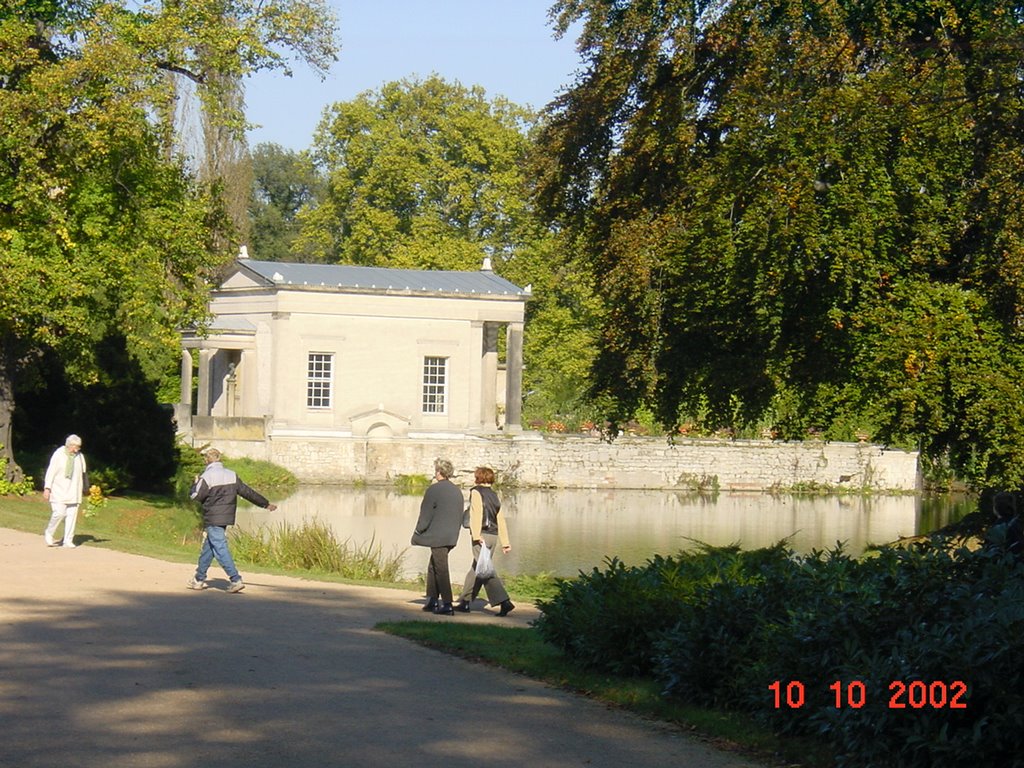
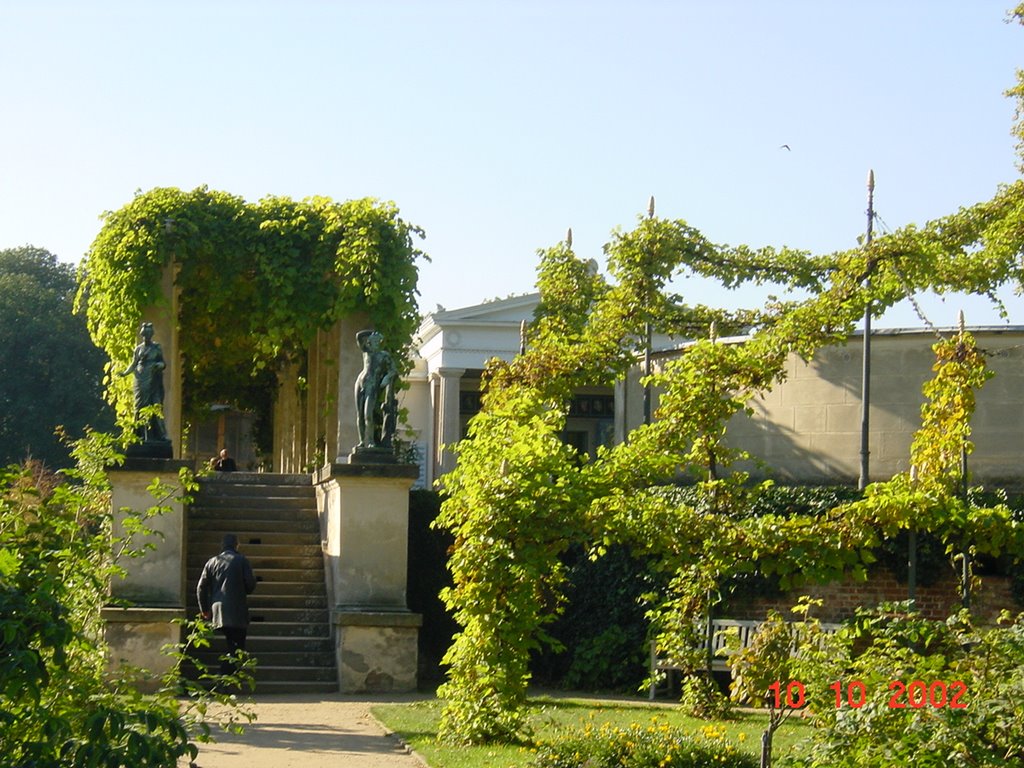
I visited Germany several years ago and spent the better part of a day in Potsdam after a short train ride from Berlin and a much longer walk than I had anticipated. I got off the train one stop too early and walked for about an hour and a half or more, across a bridge and along a river, in what I thought must be the general direction of the Schloss Sanssouci. It took a while, but I found it, although I entered the park at a point that was nearly as far as you could get from the main buildings. I had only taken a few pictures when the battery light started flashing. If I had known what to expect I would have made sure the battery was fully charged. The pictures I did get were of some smaller buildings that were put up to house, protect and display some of the ancient Roman ruins on the park grounds. If you click your mouse on the pictures once or twice, the buildings I did shoot get quite a bit bigger.
Sunday, February 26, 2006
Fredericks of Brandenburg
I don't know yet if Johann Georg Lubach was an ancestor of mine, but in investigating that possibility I've found that he led what looks to have been quite an interesting life and from what I've learned so far I don't think I'd object to having him as an ancestor. I'm not sure how he'd feel about me as a descendant.
He was born in 1672 in the town of Moeckern near Leipzig in Saxony and was apparently raised as an orphan. His status as an orphan didn't prevent him from attending the University of Halle. Completing his studies in 1697 at the age of 25, he took a job on campus straight out of college, supervising orphans and teaching at a school for them that officially opened its doors the following year in 1698. He worked there for about fifteen years, then in 1714 he moved from Halle in what is now Saxony Anhalt to Brandenburg where he settled in a town east of Berlin called Wriezen and took a job as a Kantor. He stayed there for about eight years before moving to Garlitz/Rathenow, west of Berlin, where he worked organizing churches and schools until he retired. John George Lubach eventually died in 1752, at the age of 80, in a town called Goerlitz on the Neisse in Upper Lusatia, not far from Dresden.
I don't know his wife's name or how many children he had, but it looks as if one son, Godofroy, born in 1713, had a chance to teach for awhile at the orphan school in Halle in 1736. Godofroy seems to have been a Cantor by trade. He might well have even been personally acquainted with Johann Sebastian Bach, someone who also worked as a Cantor in and near Leipzig in that era. Bach was also raised as an orphan and was about a dozen years younger than Godofroy's father.
Godofroy appears to have had two sons, Daniel, born 1741, and Gottfried, born 1744. Their father seems to have died before they attended the orphan school at Halle. They were both listed as orphans from the village of Gartz on the Oder, a little north of Schwedt, and their father's profession was listed as Cantor. They were in Halle between 1756 and 1763. One of them must have had a son at some point because another Lubach, Gotthilf, was enrolled at Halle in 1797. I don't have a birthdate or a home village for Gotthilf, but I would guess he was born around 1780 or a little after.
My ancestor, Wilhelm Lubach, was born around 1827 and he emigrated from a village in Brandenburg called Wrechow in 1856 with his wife and two small sons. Wrechow is just across the Oder about ten or twelve miles from Wriezen. A number of orphans from both villages were enrolled at the orphan school in Halle during the 18th century, so it would appear likely that the Pietists who ran the school at Halle had established churches in both villages.
One of the most interesting things about Johann Georg Lubach is that he lived to be eighty years old. Prussia was ruled by the Great Elector, Friederich Wilhelm, from 1640 up until 1688 when the orphan, Johann Georg Lubach, was sixteen years old. He died in 1752, twelve years into the reign of Frederick the Great. Between 1688 and 1740, two other Fredericks ruled Prussia, Frederick I and his son, Frederick William I, each of them for about twenty-five years.
This eighty year stretch in European history was the period in which Prussia went from being an obscure dukedom on the Baltic Sea to an empire that extended from France all the way to Russia. The orphan school in Halle where Johann Georg Lubach taught was supported by all four of these Fredericks and the students the school produced were nothing less than instrumental in making Prussia an empire.
Sunday, January 29, 2006
A Rose By Any Other Name
A year or so ago I found a webpage called the Archiv der Franckeschen Stiftungen zu Halle. I didn't know quite what to make of it at the time. But I did find it curious as there were several people listed with my surname. Those people are still listed there and, in point of fact, one more person with my surname has been added to the list.
If you click on the link you should get a long list of German surnames that start with the letter 'L'. My surname is near the bottom of the list, filed alphabetically. I won't bore you with the details of my personal concerns. The question is, what in the world is this list all about? A year ago I found it quite confusing. But the site has been updated a little in the interim and now every name on the list is a link to personal details about each of the names on the list. All of them were dead by the time America's constitution was ratified.
Halle is a city near Leipzig in the state of Saxony Anhalt, one of half a dozen or so new states established as part of the recently reunified Germany. It used to be part of East Germany and for almost half a century the information on that list would probably have been accessible to STAASI, the East German secret police.
If I had gone to East Germany when I finished graduate school during the last days of the Reagan era, someone in the state police there would probably have been obliged to consult this list. My surname is fairly unique. Simply by finding my surname on this list they would have known more about me than I know about myself.
Sunday, January 22, 2006
A House On Baltic Avenue
I signed up for Blogshares a few days ago after finding out that one of my visitors had purchased 25% of the imaginary shares in my blog. I joined so I could buy up 50% of the imaginary shares and a controlling interest with imaginary money that Blogshares gives you for signing up. I figured that at 37 cents a share it was too good a deal to pass up.
The bad news is that my blog is valued at less than B$2,000.00. The good news is that some of the other Blogshares investors were so impressed by my business acumen that they have given me shares in three other blogs worth nearly B$9,000,000.00, so now I have the wherewithal to invest in other blogs.
If you think your blog might be a good investment, do let me know. I've got imaginary money to spend. Their link is at the bottom of my blogroll. I also signed up for Adsense, but so far they haven't found any ads that make sense for my blog.
Sunday, January 08, 2006
Mr. Ed
I exhanged e-mails over the holidays with a third cousin once removed, a granddaughter of my great grandfather's sister. My cousin verified that she lived in the same house with her grandmother for a number of years up until her grandmother's death at age 77 in 1935, when she was twelve years old. She said that her grandmother's brother from Kewaskum came across the state of Wisconsin and stayed with her family in Chippewa county for a few days during the funeral. She didn't recall the name of her grandmother's brother, but that doesn't matter because I already know who it was that visited, but until now I couldn't prove it. It had to have been my great grandfather's step-brother, Ed or Edward Lubach.
My middle name is Edward. It is also my father's middle name and before that it was my grandfather's middle name. My grandfather, in fact, was known by his middle name and not by his first name. I can't prove it, but I have no doubt that my grandfather, my father and I all have the same namesake. We all got our middle initial from my great grandfather's brother, Ed, who at age 72 attended the funeral of my cousin's grandmother in 1935. I'm fairly certain that Ed was a brother by marriage and not by blood.
When my great great grandfather died in the Civil War in 1865 he left behind a widow and three children. His widow remarried in 1867. Her new husband's youngest son, Edward, was then four years old. By 1880 all three of her children, Charles, William and Louise, had married and moved away. Edward and his parents, his father and his stepmother, remained in Sheboygan county, a few miles north of the town of Kewaskum, for the rest of their lives. Edward adopted the surname of his stepmother's first husband who had died in the war.
When I put together my family history webpage a year and a half ago I had a vague hunch that this could be the case. I viewed it as an interesting possiblilty, one worth exploring, but now I have no doubt whatsoever.
Sunday, January 01, 2006
Santa's Chimney
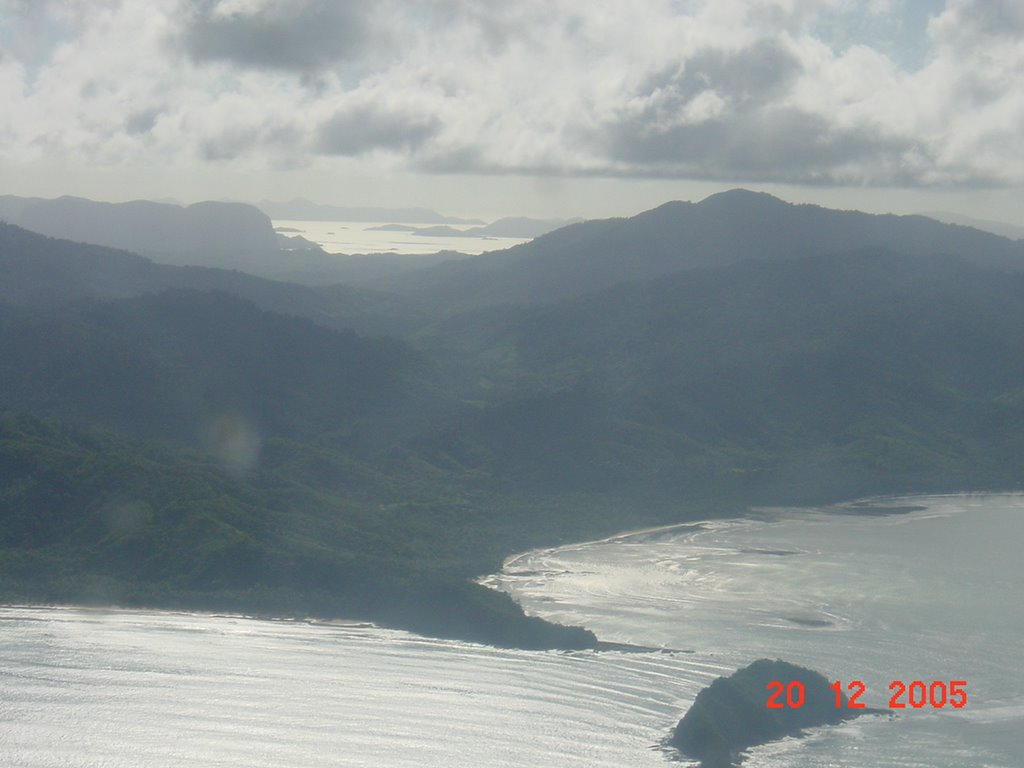
 I spent at least part of my Christmas holiday thirty feet off the ground with my rear end in a sling.
My wife and I went to a resort in Palawan, one of the least developed provinces in the Philippines. The island is long and narrow, extending most of the way from Luzon to Borneo on the westernmost side of the archipelago.
The resort, El Nido, offered rock-climbing as one of its numerous diversions and naturally I couldn't resist. The picture was taken by one of my climbing guides, a 23 year old Filipina who was on the ground attached to the other end of my rope, patiently waiting for me to lose my grip. Somehow I managed to get back on the ground without doing any permanent damage to myself or the rock face. The painful part was hearing how impressed my guide was that someone my age, fifty-two, would attempt something so strenuous. Two or three days later I could nearly raise my right arm over my head.
Click on the pictures to see enlarged versions. I've got more if you'd like to see them.
Sunday, December 11, 2005
Dock of the Bay
My German immigrant great great grandfather, who I discovered on the internet during the past two years, spent the last six months of his life on the Gulf Coast in Arkansas, Louisiana, Alabama, Mississippi and Texas in the final months and aftermath of the American Civil War. He took part in only one real battle, the assault on Spanish Fort and Fort Blakeley, the forts on Mobile Bay that kept Mobile from falling into Union hands until after Robert E. Lee had already surrendered in Virginia in April, 1865.
A few weeks ago I mentioned a recent book by Andrew Ward called 'River Run Red', an account of the Fort Pillow Massacre, which took place on the Mississippi River north of Memphis in April, 1864, an event about which I knew nothing until I encountered Ward's book. To be honest, I had never even heard of Fort Pillow, an incident in which surrendering Union soldiers, mostly 'colored troops', were given no quarter and slaughtered by their Confederate captors. But I have since uncovered a few articles about the fall of Mobile which suggest that the memory of Fort Pillow figured prominently in the battle that delivered Mobile to Union occupation.
Michael Fitzgerald, a history professor at St. Olaf College in Northfield, Minnesota, wrote an article published in 2001 in the Alabama Review entitled 'Another Kind of Glory: Black Participation and Its Consequences in the Campaign for Confederate Mobile.' According to Fitzgerald nearly one fourth of the 50,000 or more Union troops assembled for the assault on the forts defending Mobile were "colored troops", largely freed slaves from southern plantations recruited and trained specifically for the siege of Mobile.
"Remember Fort Pillow," was apparently the battle cry heard from the 'colored troops' massed along the river on the right flank at Fort Blakeley as they charged the Confederate lines a full half hour before the signal to attack was given. So many of the Confederate defenders in the trench line around the fort had moved to the flank to repel the premature charge, according to Fitzgerald, that the center of the line offered little resistance when the main attack ensued.
Sunday, November 27, 2005
Another Manila Sunrise
 These are a few snapshots I took a few weeks ago on a day when I got up early enough for a round of golf. The pictures were taken at about fifteen minute intervals between 5:30 and 6:00 a.m.. The view is of the Makati highrise district along the midpoint of the Epiphanios De Los Santos, more commonly known as EDSA. Click on the pictures to see enlarged versions of them.
I received several e-mails since my last post, one from a woman in Virginia with roots in Indiana who wanted permission to send copies of one of my early posts, Not Quite White, to family and friends in Indiana for Christmas. She thinks she might also have some native American ancestry from the Indiana frontier and seemed to think I must have a sense of humor.
Another e-mail was from a neighbor of someone I mentioned in a more recent post about relations and in-laws I discovered through census records and who still lives in Bloomer, Wisconsin. I plan to follow-up on that one, but I'm not yet sure how.

 The third e-mail I got this week came in today.
It's from Lowell Schake, whose book about life on the Missouri frontier in LaCharrette Village has now been published. I'll have to keep an eye out to see if it turns up in any of the bookstores here in Manila.
That's about all I've got for now.
Sunday, November 13, 2005
River Run Red
When I was on home leave in Seattle several months ago I finally had an opportunity to meet the author, Andrew Ward, in person. My wife taught in the same department at the university as his wife a dozen or so years ago, so I had known about him for quite some time and had read several of his books. He told me had written another one, this time a book about an incident from the Civil War. It hadn't yet been published then, but it has now and I was able to buy it at a bookstore here in Manila last week. It's not yet out in paperback (don't hold your breath), but it's well worth the hardbound price. Ken Burns himself wrote the blurb on the back cover.
Ward anatomizes a Civil War battle fought in western Tennessee in April, 1864, known as the Fort Pillow Massacre. The book deals with the efforts of the Union army to enlist what were known then as "colored troops" after the slaves in the southern states had been freed by the Emancipation Proclamation early in 1863. I haven't yet read the whole book, so I won't try to review it here, but much of the story revolves around a Confederate cavalry general and local slave dealer, Nathan Bedford Forrest, who many people regard as the founder of the Ku Klux Klan. The reputation he developed and the methods he employed in that massacre do much to explain how the Klan came into being and has managed to persist for nearly a century and a half.
The book is particularly interesting to me because my German immigrant great great grandfather served with the 27th Wisconsin Infantry, a unit that spent most of the war in Arkansas, directly across the Mississippi River from Fort Pillow. My ancestor didn't join the unit until early 1865 as a replacement troop. He was in Arkansas for only a few days or perhaps a week or two at most before the unit went downriver to New Orleans in preparation for the siege of Mobile, but the men of his regiment had spent the previous two years in circumstances almost identical to those painstakingly described in Ward's book.
A primary mission for the Department of Arkansas under General Frederick Steele was to recruit, organize and train "colored troops" from among the many freed slaves in Arkansas. When the forts fell in Mobile in April, 1865, the fortifications there were breached by "colored troops" while my great great grandfather's unit and many others were held back in reserve.
Subscribe to:
Posts (Atom)