My German immigrant great great grandfather, who I discovered on the internet during the past two years, spent the last six months of his life on the Gulf Coast in Arkansas, Louisiana, Alabama, Mississippi and Texas in the final months and aftermath of the American Civil War. He took part in only one real battle, the assault on Spanish Fort and Fort Blakeley, the forts on Mobile Bay that kept Mobile from falling into Union hands until after Robert E. Lee had already surrendered in Virginia in April, 1865.
A few weeks ago I mentioned a recent book by Andrew Ward called 'River Run Red', an account of the Fort Pillow Massacre, which took place on the Mississippi River north of Memphis in April, 1864, an event about which I knew nothing until I encountered Ward's book. To be honest, I had never even heard of Fort Pillow, an incident in which surrendering Union soldiers, mostly 'colored troops', were given no quarter and slaughtered by their Confederate captors. But I have since uncovered a few articles about the fall of Mobile which suggest that the memory of Fort Pillow figured prominently in the battle that delivered Mobile to Union occupation.
Michael Fitzgerald, a history professor at St. Olaf College in Northfield, Minnesota, wrote an article published in 2001 in the Alabama Review entitled 'Another Kind of Glory: Black Participation and Its Consequences in the Campaign for Confederate Mobile.' According to Fitzgerald nearly one fourth of the 50,000 or more Union troops assembled for the assault on the forts defending Mobile were "colored troops", largely freed slaves from southern plantations recruited and trained specifically for the siege of Mobile.
"Remember Fort Pillow," was apparently the battle cry heard from the 'colored troops' massed along the river on the right flank at Fort Blakeley as they charged the Confederate lines a full half hour before the signal to attack was given. So many of the Confederate defenders in the trench line around the fort had moved to the flank to repel the premature charge, according to Fitzgerald, that the center of the line offered little resistance when the main attack ensued.
Sunday, December 11, 2005

Sunday, November 27, 2005
Another Manila Sunrise
 These are a few snapshots I took a few weeks ago on a day when I got up early enough for a round of golf. The pictures were taken at about fifteen minute intervals between 5:30 and 6:00 a.m.. The view is of the Makati highrise district along the midpoint of the Epiphanios De Los Santos, more commonly known as EDSA. Click on the pictures to see enlarged versions of them.
I received several e-mails since my last post, one from a woman in Virginia with roots in Indiana who wanted permission to send copies of one of my early posts, Not Quite White, to family and friends in Indiana for Christmas. She thinks she might also have some native American ancestry from the Indiana frontier and seemed to think I must have a sense of humor.
Another e-mail was from a neighbor of someone I mentioned in a more recent post about relations and in-laws I discovered through census records and who still lives in Bloomer, Wisconsin. I plan to follow-up on that one, but I'm not yet sure how.

 The third e-mail I got this week came in today.
It's from Lowell Schake, whose book about life on the Missouri frontier in LaCharrette Village has now been published. I'll have to keep an eye out to see if it turns up in any of the bookstores here in Manila.
That's about all I've got for now.
Sunday, November 13, 2005
River Run Red
When I was on home leave in Seattle several months ago I finally had an opportunity to meet the author, Andrew Ward, in person. My wife taught in the same department at the university as his wife a dozen or so years ago, so I had known about him for quite some time and had read several of his books. He told me had written another one, this time a book about an incident from the Civil War. It hadn't yet been published then, but it has now and I was able to buy it at a bookstore here in Manila last week. It's not yet out in paperback (don't hold your breath), but it's well worth the hardbound price. Ken Burns himself wrote the blurb on the back cover.
Ward anatomizes a Civil War battle fought in western Tennessee in April, 1864, known as the Fort Pillow Massacre. The book deals with the efforts of the Union army to enlist what were known then as "colored troops" after the slaves in the southern states had been freed by the Emancipation Proclamation early in 1863. I haven't yet read the whole book, so I won't try to review it here, but much of the story revolves around a Confederate cavalry general and local slave dealer, Nathan Bedford Forrest, who many people regard as the founder of the Ku Klux Klan. The reputation he developed and the methods he employed in that massacre do much to explain how the Klan came into being and has managed to persist for nearly a century and a half.
The book is particularly interesting to me because my German immigrant great great grandfather served with the 27th Wisconsin Infantry, a unit that spent most of the war in Arkansas, directly across the Mississippi River from Fort Pillow. My ancestor didn't join the unit until early 1865 as a replacement troop. He was in Arkansas for only a few days or perhaps a week or two at most before the unit went downriver to New Orleans in preparation for the siege of Mobile, but the men of his regiment had spent the previous two years in circumstances almost identical to those painstakingly described in Ward's book.
A primary mission for the Department of Arkansas under General Frederick Steele was to recruit, organize and train "colored troops" from among the many freed slaves in Arkansas. When the forts fell in Mobile in April, 1865, the fortifications there were breached by "colored troops" while my great great grandfather's unit and many others were held back in reserve.
Ward anatomizes a Civil War battle fought in western Tennessee in April, 1864, known as the Fort Pillow Massacre. The book deals with the efforts of the Union army to enlist what were known then as "colored troops" after the slaves in the southern states had been freed by the Emancipation Proclamation early in 1863. I haven't yet read the whole book, so I won't try to review it here, but much of the story revolves around a Confederate cavalry general and local slave dealer, Nathan Bedford Forrest, who many people regard as the founder of the Ku Klux Klan. The reputation he developed and the methods he employed in that massacre do much to explain how the Klan came into being and has managed to persist for nearly a century and a half.
The book is particularly interesting to me because my German immigrant great great grandfather served with the 27th Wisconsin Infantry, a unit that spent most of the war in Arkansas, directly across the Mississippi River from Fort Pillow. My ancestor didn't join the unit until early 1865 as a replacement troop. He was in Arkansas for only a few days or perhaps a week or two at most before the unit went downriver to New Orleans in preparation for the siege of Mobile, but the men of his regiment had spent the previous two years in circumstances almost identical to those painstakingly described in Ward's book.
A primary mission for the Department of Arkansas under General Frederick Steele was to recruit, organize and train "colored troops" from among the many freed slaves in Arkansas. When the forts fell in Mobile in April, 1865, the fortifications there were breached by "colored troops" while my great great grandfather's unit and many others were held back in reserve.
Sunday, November 06, 2005
House That Ruth Built
When I was about six years old my family drove from Kansas to South Bend, Indiana, for a summertime visit to my mother's family. Bud and Carlie Steele were the only grandparents I ever knew, as my dad's parents in Wisconsin had passed on before I was born.
The year was 1959. It was the last time the White Sox went to the World Series until just last month. My dad was a big Sox fan then, as my folks had gone to college in Chicago about ten years earlier. At age 6 I was already a Yankee fan, which my dad considered heretical. But in those days, televised baseball consisted of the Yankee powerhouse and whatever collection of bums they happened to be playing that Saturday. Dizzy Dean and PeeWee Reese provided color commentary and play-by-play every week. The Yankees had Mantle and Maris in the outfield, Kubek and Richardson up the middle, Boyer and Skowron at the corners and the battery of old Whitey Ford and Don Larsen throwing the pill to old Yogi Berra, backed up by the young rookies, Mel Stottlemyer throwing to Elston Howard.
I met my great grandparents on that trip, Ira and Stella Ruth. They were about eighty-five years old then and living independently in a three-story rooming house that my great grandfather had built back when automobiles were still a novelty item. I remember lots of wooden stairs and a living room with countless porcelain knickknacks and my mother was quite concerned that I might break some of them if I wasn't careful. My great grandparents walked with canes; they didn't hear well and their memories were going. My great grandfather had developed a habit of going out for morning walks and getting lost on his way back home and this was mostly what my mother and her mother talked about while my sisters and I eyeballed the antiques we were enjoined from damaging.
My mother passed on about six years ago and her mother died ten years before that in 1990 at the age of 90. I never really learned much from them about the Ruths except that it seemed they had always lived in South Bend, although in fact I don't think they moved there until after the turn of the century. Since joining Ancestry.com and gaining access to the census records a few weeks ago, I've already learned more than my mother or my grandmother ever told me about them. I really had no idea what their history was.
My grandmother's father, Ira Ruth, was living in LaGrange County in Indiana in 1900, which is about thirty miles east of South Bend. He and Stella and their first child, Carlie, my grandmother, lived in Van Buren Township practically on the stateline between Indiana and Michigan. My great grandmother was listed as Mary Ruth in 1910 and in 1920, but in 1900 she called herself Stella. She was born in Indiana. Her husband, Ira, called himself a farmer then. My grandmother was a newborn infant, one month old, in 1900. The family moved to South Bend between 1900 and 1910 and moved again to the 7th Ward in Portage Township in downtown South Bend between 1910 and 1920. By then Ira called himself a carpenter and I suspect he had already built the three-story boarding house I visited in 1959.
Before 1900, Ira Ruth had lived in Michigan where he was born in 1874. His parents were Augustus and Sarah (Andre?) Ruth. They were apparently both born in Lower Mt. Bethel Township in Northampton County in Pennsylvania, very close to the New Jersey stateline, about ten miles north of Easton, PA.. Augustus Ruth was the son of John Ruth, a wheelwright in Northampton County, Pennsylvania, who was born in 1817. John and Anna Ruth moved to Michigan with their sons Michael and Augustus in 1867 and the family lived in Park Township in St. Joseph County, Michigan, where they were listed as farmers in 1870.
Augustus and Sarah (Andre) Ruth were married in Michigan shortly after 1870. Both of their families had lived in eastern Pennsylvania for perhaps more than a hundred years in a predominately Swiss-German community that had settled there when the land was still occupied by Delaware Indians. The arrival of Germans in the 1750s had helped to precipitate the French and Indian War. I don't yet have a name for John Ruth's father or grandfather, but his milieu suggests that his ancestors were part of the same wave of immigration that brought my grandfather's family, the Steeles, to Pennsylvania in the 1750s.
My understanding is that the baseball player, George Herman Ruth, was born in Baltimore, Maryland in 1895 and raised in an orphanage, according to a biography that I read many years ago, written by the late great sportswriter, Bob Considine. He seems to have been named after his father who was also a George Herman Ruth, but beyond that not much is known about the Bambino's ancestry. Baltimore is certainly close enough to Philadelphia that it is possible for the Babe to have been a distant relative. His father would have been born shortly after the Civil War, just at the point when my ancestors were moving west to Lake Michigan.
The year was 1959. It was the last time the White Sox went to the World Series until just last month. My dad was a big Sox fan then, as my folks had gone to college in Chicago about ten years earlier. At age 6 I was already a Yankee fan, which my dad considered heretical. But in those days, televised baseball consisted of the Yankee powerhouse and whatever collection of bums they happened to be playing that Saturday. Dizzy Dean and PeeWee Reese provided color commentary and play-by-play every week. The Yankees had Mantle and Maris in the outfield, Kubek and Richardson up the middle, Boyer and Skowron at the corners and the battery of old Whitey Ford and Don Larsen throwing the pill to old Yogi Berra, backed up by the young rookies, Mel Stottlemyer throwing to Elston Howard.
I met my great grandparents on that trip, Ira and Stella Ruth. They were about eighty-five years old then and living independently in a three-story rooming house that my great grandfather had built back when automobiles were still a novelty item. I remember lots of wooden stairs and a living room with countless porcelain knickknacks and my mother was quite concerned that I might break some of them if I wasn't careful. My great grandparents walked with canes; they didn't hear well and their memories were going. My great grandfather had developed a habit of going out for morning walks and getting lost on his way back home and this was mostly what my mother and her mother talked about while my sisters and I eyeballed the antiques we were enjoined from damaging.
My mother passed on about six years ago and her mother died ten years before that in 1990 at the age of 90. I never really learned much from them about the Ruths except that it seemed they had always lived in South Bend, although in fact I don't think they moved there until after the turn of the century. Since joining Ancestry.com and gaining access to the census records a few weeks ago, I've already learned more than my mother or my grandmother ever told me about them. I really had no idea what their history was.
My grandmother's father, Ira Ruth, was living in LaGrange County in Indiana in 1900, which is about thirty miles east of South Bend. He and Stella and their first child, Carlie, my grandmother, lived in Van Buren Township practically on the stateline between Indiana and Michigan. My great grandmother was listed as Mary Ruth in 1910 and in 1920, but in 1900 she called herself Stella. She was born in Indiana. Her husband, Ira, called himself a farmer then. My grandmother was a newborn infant, one month old, in 1900. The family moved to South Bend between 1900 and 1910 and moved again to the 7th Ward in Portage Township in downtown South Bend between 1910 and 1920. By then Ira called himself a carpenter and I suspect he had already built the three-story boarding house I visited in 1959.
Before 1900, Ira Ruth had lived in Michigan where he was born in 1874. His parents were Augustus and Sarah (Andre?) Ruth. They were apparently both born in Lower Mt. Bethel Township in Northampton County in Pennsylvania, very close to the New Jersey stateline, about ten miles north of Easton, PA.. Augustus Ruth was the son of John Ruth, a wheelwright in Northampton County, Pennsylvania, who was born in 1817. John and Anna Ruth moved to Michigan with their sons Michael and Augustus in 1867 and the family lived in Park Township in St. Joseph County, Michigan, where they were listed as farmers in 1870.
Augustus and Sarah (Andre) Ruth were married in Michigan shortly after 1870. Both of their families had lived in eastern Pennsylvania for perhaps more than a hundred years in a predominately Swiss-German community that had settled there when the land was still occupied by Delaware Indians. The arrival of Germans in the 1750s had helped to precipitate the French and Indian War. I don't yet have a name for John Ruth's father or grandfather, but his milieu suggests that his ancestors were part of the same wave of immigration that brought my grandfather's family, the Steeles, to Pennsylvania in the 1750s.
My understanding is that the baseball player, George Herman Ruth, was born in Baltimore, Maryland in 1895 and raised in an orphanage, according to a biography that I read many years ago, written by the late great sportswriter, Bob Considine. He seems to have been named after his father who was also a George Herman Ruth, but beyond that not much is known about the Bambino's ancestry. Baltimore is certainly close enough to Philadelphia that it is possible for the Babe to have been a distant relative. His father would have been born shortly after the Civil War, just at the point when my ancestors were moving west to Lake Michigan.
Sunday, October 23, 2005
Heman
Well, I've had a field day with online access to the U.S. census records and I've learned a few things. One of the main things I've learned is that before 1910 my Boettcher ancestors spelled their name with one "t", as Boetcher, instead of the more usual spelling with two "tt"s.
I found my great great grandfather, John Boetcher, living in "Heman" township in Dodge County in Wisconsin in 1860, along with his wife, Minnie, and their children, Charles (Carl), Auguste, Herman and Hanna. The family immigrated in 1856, arriving in August according to my aunt, and that explains why Carl and Auguste were born in Prussia, while Herman and Hanna were born in Wisconsin. Dodge County has no records of a town or township called "Heman", but it did, like Sheboygan County, have a Herman Township that was popular with Prussian immigrants.
Their next door neighbor in "Heman" was a couple named John and Albertine Backhaus. John Backhaus was 46 and his wife, Albertine, was 24. Their oldest son was William, aged 13, which suggests that John had a previous spouse, unless Albertine gave birth at age 11. I haven't located either family in the 1870 census, but in 1880, John and Minnie Boetcher lived at Eagle Point in Chippewa County and their daughter, Hanna, was also there, married to my great grandfather, William Lubach. John and Minnie's next door neighbor in 1880 was the widow, Albertine Backhaus. I didn't find John Backhaus, which suggests he must already have passed on at that point.
More than 2,500 people lived in Eagle Point in 1880, according to the census. The town was named after "Old Abe", the war eagle who served as a mascot for the 2nd Wisconsin Infantry, a part of the "Iron Brigade", easily the most celebrated of all of the Wisconsin units that served in the Civil War. Old Abe was purchased upriver from some Chippewa (Ojibwa) Indians and raised as a pet by members of the McCann clan who settled in Eagle Point shortly after the Blackhawk War of 1832. Members of the McCann family had known and worked with Jefferson Davis, president of the Confederacy, when he was a young lieutenant and later a captain during the Blackhawk War.
The McCann clan essentially built Chippewa Falls from the ground up. They were the lumber business on the Chippewa River. During the 1870s farmers began arriving there, many of them German, Scandinavian and Bohemian or Slovakian. Tilden, where my ancestors established their homestead, Woodmohr, was not yet a township in 1880, so it appears that records for this influx of farmers were maintained at Eagle Point. The 1890 census for Wisconsin was destroyed in a fire, but in 1900 many of the families listed as living in Eagle Point in 1880 had long been settled in Tilden Township. Among the settlers listed at Eagle Point in 1880 was John Boetcher's father, Christian Boetcher, who was born in Prussia in 1794.
I mention Albertine Backhaus here because in 1860 my great grandfather, William Lubach, was living in Sheboygan County not far from Lake Michigan. He was four years old and lived in Scott Township. His neighbors on one side were the Ludwig and Henrietta Backhaus family and on the other side were Wilhelm and Maria D. Ebert and their family. The next nearest neighbors on that side were August and Sophia Heise. William's father, Wilhelm Lubach, fought in the Civil War along with August Heise in Company F of the 27th Wisconsin Infantry. August Heise returned; Wilhelm Lubach didn't.
Wilhelm Ebert's son, William, joined the 12th Wisconsin Infantry on February 22nd, 1864, when he was twenty years old. He was severely wounded at Bald Hill on July 21st, and saw some of the fiercest fighting in the Battle of Atlanta. He was discharged in January 1865 and returned to Scott Township where he was declared an invalid in February so that he and his wife, Fredericke, could receive a disability pension. According to the government he collected that pension until 1916. He and Fredericke raised a family in Scott Township. A blogpost I published in December last year, headed Gone With The Wind, details some of William Ebert's Civil War experience.
Wilhelm Lubach's widow, Maria, according to government pension records, married her next door neighbor, Ludwig Backhaus. I don't know what happened to Ludwig's wife, Henrietta, but I do know that in 1870 , a child named Edward, born in 1862 or 1863, was part of the Ludwig and Mary Backhaus household. I suspect that Henrietta may have died giving birth to Edward. The 1865 state census for Wisconsin lists only three children for the Lubach family, Carl, William and Louise. I would think Edward would have been listed as a fourth child if he was actually born a Lubach. He was listed as a Backhaus in the U.S. census of 1870.
Edward Lubach doesn't appear in the 1880 census and the 1890 census was destroyed in a fire, but in 1900 he and his wife, Catharine A. (Luhn) are living in Scott Township, along with a son, Edward, age 12, and five daughters. Also included in the household is his mother-in-law, Catharine Luhn. The 1860 census has her married to Jacob Luhn, a Prussian who was part of the same cluster with the Ebert, Lubach, Backhaus and Heise families. Catharine was from Hessen Darmstadt. The family disappears again in 1910, except for two of the children, Alexander, 23, and Ella, 19, who are listed in nearby Lynden Township as servants in the Charles Sibley household. Edward and Catharine appear again in 1920 in Scott Township with two more daughters who were not yet born in 1900. Their next door neighbors in 1920 are Alexander and Selma Lubach, who have recently blessed them with a granddaughter, Arline, and a grandson, Edward.
My great great grandmother, Marie Lubach, experienced a little trauma during the Civil War. A German emigration record suggests that Marie had a sister named Sophie and that they were the daughters of Wilhelm and Maria D. Ebert, their next door neighbors. Sophie was married to August Heise, who went off to war on the gulf coast with Wilhelm Lubach in January, 1865. A month later, William Ebert, the Ebert sisters' younger brother, returned from the war early with a severe wound and a disability pension. Two years later, Marie was a grieving widow married to her next door neighbor and raising a child whose mother, most likely, had died during the war. Her sons, Carl and William, don't appear in the 1870 census, but in 1880 Carl has married Catharine (Guth) up north in Fondulac. They will live in nearby Kewaskum for a few years before moving to Ohio where they will lose three sons to a diptheria epidemic in 1893. William has married Hanna (Boetcher) way out west in Chippewa. Marie's daughter, Louise, age 12, is still at home in Scott in 1870. She married Carl Boetcher in Sheboygan County in 1880, shortly before they also moved west to Chippewa.
Two months ago I published a post on this blog headed Bloomer Advance with a link to a letter written by Vernon Kressin earlier this year. The letter indicated that he and his wife, Lois, had visited the grave of Wilhelm Lubach, who fought in the Civil War and died in St. Louis. Vernon Kressin's ancestors are listed living in Eagle Point in 1880. Lois Kressin is the daughter of Carl and Louise Boettcher's son, Edwin, who was born in Tilden Township. If her claim to be the great granddaughter of Wilhelm Lubach is true, it virtually cinches my claim that Hanna (Boetcher) Lubach was the younger sister of Carl Boettcher and that Louise (Lubach) Boettcher was the younger sister of William Lubach.
Most of the people in America with my surname, Lubach, live in Sheboygan, Wisconsin. I don't think any of them are related to me, but some of them do have an an ancestor who was raised by my great great grandmother.
The town of Kewaskum is five or ten miles south of Scott Township in Sheboygan County and ten or twenty miles east of Herman Township in Dodge County. If you visit Kewaskum do take a tour of the cemeteries. You'll see world class gothic monuments. Roughly a third of the people buried in those cemeteries are named Backhaus. I don't know yet exactly how Ludwig Backhaus (b. 1815) in Scott Township and John Backhaus (b. 1813) in Herman Township were related, but I'll bet you a hundred dollars they were.
I found my great great grandfather, John Boetcher, living in "Heman" township in Dodge County in Wisconsin in 1860, along with his wife, Minnie, and their children, Charles (Carl), Auguste, Herman and Hanna. The family immigrated in 1856, arriving in August according to my aunt, and that explains why Carl and Auguste were born in Prussia, while Herman and Hanna were born in Wisconsin. Dodge County has no records of a town or township called "Heman", but it did, like Sheboygan County, have a Herman Township that was popular with Prussian immigrants.
Their next door neighbor in "Heman" was a couple named John and Albertine Backhaus. John Backhaus was 46 and his wife, Albertine, was 24. Their oldest son was William, aged 13, which suggests that John had a previous spouse, unless Albertine gave birth at age 11. I haven't located either family in the 1870 census, but in 1880, John and Minnie Boetcher lived at Eagle Point in Chippewa County and their daughter, Hanna, was also there, married to my great grandfather, William Lubach. John and Minnie's next door neighbor in 1880 was the widow, Albertine Backhaus. I didn't find John Backhaus, which suggests he must already have passed on at that point.
More than 2,500 people lived in Eagle Point in 1880, according to the census. The town was named after "Old Abe", the war eagle who served as a mascot for the 2nd Wisconsin Infantry, a part of the "Iron Brigade", easily the most celebrated of all of the Wisconsin units that served in the Civil War. Old Abe was purchased upriver from some Chippewa (Ojibwa) Indians and raised as a pet by members of the McCann clan who settled in Eagle Point shortly after the Blackhawk War of 1832. Members of the McCann family had known and worked with Jefferson Davis, president of the Confederacy, when he was a young lieutenant and later a captain during the Blackhawk War.
The McCann clan essentially built Chippewa Falls from the ground up. They were the lumber business on the Chippewa River. During the 1870s farmers began arriving there, many of them German, Scandinavian and Bohemian or Slovakian. Tilden, where my ancestors established their homestead, Woodmohr, was not yet a township in 1880, so it appears that records for this influx of farmers were maintained at Eagle Point. The 1890 census for Wisconsin was destroyed in a fire, but in 1900 many of the families listed as living in Eagle Point in 1880 had long been settled in Tilden Township. Among the settlers listed at Eagle Point in 1880 was John Boetcher's father, Christian Boetcher, who was born in Prussia in 1794.
I mention Albertine Backhaus here because in 1860 my great grandfather, William Lubach, was living in Sheboygan County not far from Lake Michigan. He was four years old and lived in Scott Township. His neighbors on one side were the Ludwig and Henrietta Backhaus family and on the other side were Wilhelm and Maria D. Ebert and their family. The next nearest neighbors on that side were August and Sophia Heise. William's father, Wilhelm Lubach, fought in the Civil War along with August Heise in Company F of the 27th Wisconsin Infantry. August Heise returned; Wilhelm Lubach didn't.
Wilhelm Ebert's son, William, joined the 12th Wisconsin Infantry on February 22nd, 1864, when he was twenty years old. He was severely wounded at Bald Hill on July 21st, and saw some of the fiercest fighting in the Battle of Atlanta. He was discharged in January 1865 and returned to Scott Township where he was declared an invalid in February so that he and his wife, Fredericke, could receive a disability pension. According to the government he collected that pension until 1916. He and Fredericke raised a family in Scott Township. A blogpost I published in December last year, headed Gone With The Wind, details some of William Ebert's Civil War experience.
Wilhelm Lubach's widow, Maria, according to government pension records, married her next door neighbor, Ludwig Backhaus. I don't know what happened to Ludwig's wife, Henrietta, but I do know that in 1870 , a child named Edward, born in 1862 or 1863, was part of the Ludwig and Mary Backhaus household. I suspect that Henrietta may have died giving birth to Edward. The 1865 state census for Wisconsin lists only three children for the Lubach family, Carl, William and Louise. I would think Edward would have been listed as a fourth child if he was actually born a Lubach. He was listed as a Backhaus in the U.S. census of 1870.
Edward Lubach doesn't appear in the 1880 census and the 1890 census was destroyed in a fire, but in 1900 he and his wife, Catharine A. (Luhn) are living in Scott Township, along with a son, Edward, age 12, and five daughters. Also included in the household is his mother-in-law, Catharine Luhn. The 1860 census has her married to Jacob Luhn, a Prussian who was part of the same cluster with the Ebert, Lubach, Backhaus and Heise families. Catharine was from Hessen Darmstadt. The family disappears again in 1910, except for two of the children, Alexander, 23, and Ella, 19, who are listed in nearby Lynden Township as servants in the Charles Sibley household. Edward and Catharine appear again in 1920 in Scott Township with two more daughters who were not yet born in 1900. Their next door neighbors in 1920 are Alexander and Selma Lubach, who have recently blessed them with a granddaughter, Arline, and a grandson, Edward.
My great great grandmother, Marie Lubach, experienced a little trauma during the Civil War. A German emigration record suggests that Marie had a sister named Sophie and that they were the daughters of Wilhelm and Maria D. Ebert, their next door neighbors. Sophie was married to August Heise, who went off to war on the gulf coast with Wilhelm Lubach in January, 1865. A month later, William Ebert, the Ebert sisters' younger brother, returned from the war early with a severe wound and a disability pension. Two years later, Marie was a grieving widow married to her next door neighbor and raising a child whose mother, most likely, had died during the war. Her sons, Carl and William, don't appear in the 1870 census, but in 1880 Carl has married Catharine (Guth) up north in Fondulac. They will live in nearby Kewaskum for a few years before moving to Ohio where they will lose three sons to a diptheria epidemic in 1893. William has married Hanna (Boetcher) way out west in Chippewa. Marie's daughter, Louise, age 12, is still at home in Scott in 1870. She married Carl Boetcher in Sheboygan County in 1880, shortly before they also moved west to Chippewa.
Two months ago I published a post on this blog headed Bloomer Advance with a link to a letter written by Vernon Kressin earlier this year. The letter indicated that he and his wife, Lois, had visited the grave of Wilhelm Lubach, who fought in the Civil War and died in St. Louis. Vernon Kressin's ancestors are listed living in Eagle Point in 1880. Lois Kressin is the daughter of Carl and Louise Boettcher's son, Edwin, who was born in Tilden Township. If her claim to be the great granddaughter of Wilhelm Lubach is true, it virtually cinches my claim that Hanna (Boetcher) Lubach was the younger sister of Carl Boettcher and that Louise (Lubach) Boettcher was the younger sister of William Lubach.
Most of the people in America with my surname, Lubach, live in Sheboygan, Wisconsin. I don't think any of them are related to me, but some of them do have an an ancestor who was raised by my great great grandmother.
The town of Kewaskum is five or ten miles south of Scott Township in Sheboygan County and ten or twenty miles east of Herman Township in Dodge County. If you visit Kewaskum do take a tour of the cemeteries. You'll see world class gothic monuments. Roughly a third of the people buried in those cemeteries are named Backhaus. I don't know yet exactly how Ludwig Backhaus (b. 1815) in Scott Township and John Backhaus (b. 1813) in Herman Township were related, but I'll bet you a hundred dollars they were.
Sunday, October 16, 2005
In a Dark Time
Well, I've done it now. I finally broke down and shelled out the bucks for an Ancestry.com membership. Nearly all of the information I've accumulated and posted about my family history on my webpage in the past three years, and here on my blog in the past year, has come from the internet free of charge. So why am I now willing to part with the big bucks? Am I selling out? Do the pay sites suddenly have vital information worth more than ten dollars a month to me? I don't think so, on either count.
The main thing you get with a membership is comprehensive access to several main sets of database records, the largest and most important of these being the U.S. Federal Census Records and the Social Security Death Index. You can search these records without being a paying member; you just can't see the results. Instead all you get is an indication of the number of hits on your search item in those databases. But simply knowing that there are hits can be a very useful clue. When there are hits, the specifics can often be accessed elsewhere free of charge.
Rootsweb and U.S. GenWeb are large free database projects that make relevant portions of the federal census records and other databases available to localized free genealogy websites. Most counties in America have one or more websites that exist solely for the purpose of making records available to people whose roots are in that locality. So if you know what you are looking for and where to look for it on the web, you can usually find it. What Ancestry.com and other paysites sell is convenient and comprehensive access.
I guess what's happened to me is that I've reached the point where I've decided I don't mind paying for convenient, comprehensive access. First, I can afford it. Second, it's a worthwhile product. And third, I've reached a point where I can start to make use of some of the vast quantity of information that is related less specifically to my particular ancestors. Comprehensive access allows you to make better generalizations based on peripheral data.
I'm fortunate to have at least one fairly distinctive surname to trace. My last name is not one that you encounter everyday. If you were to canvas all of the phone books in America, you would find fewer people with my surname than you would find listed under Smith or Jones in any one small town in America. And with only a few hundred or perhaps one or two thousand total listings to draw on, it's not that hard to eliminate those that are probably not directly related to me.
While the items that I have found and posted on my webpage are not necessarily always the proverbial "smoking gun" of definitive proof, they are often enough sufficient evidence on which to base an assumption or a supposition. And when a supposition leads directly or even indirectly to a subsequent find, it indicates something about the validity of that supposition.
Now for something completely unrelated, I've added another reciprocal link to my blogroll.
In a Dark Time features some terrific wildlife photography and some excellent commentary and personal reflections on poems by many of the most significant modern American poets of the past century. I include it here because of the entries on Theodore Roethke and Nelson Bentley.
The main thing you get with a membership is comprehensive access to several main sets of database records, the largest and most important of these being the U.S. Federal Census Records and the Social Security Death Index. You can search these records without being a paying member; you just can't see the results. Instead all you get is an indication of the number of hits on your search item in those databases. But simply knowing that there are hits can be a very useful clue. When there are hits, the specifics can often be accessed elsewhere free of charge.
Rootsweb and U.S. GenWeb are large free database projects that make relevant portions of the federal census records and other databases available to localized free genealogy websites. Most counties in America have one or more websites that exist solely for the purpose of making records available to people whose roots are in that locality. So if you know what you are looking for and where to look for it on the web, you can usually find it. What Ancestry.com and other paysites sell is convenient and comprehensive access.
I guess what's happened to me is that I've reached the point where I've decided I don't mind paying for convenient, comprehensive access. First, I can afford it. Second, it's a worthwhile product. And third, I've reached a point where I can start to make use of some of the vast quantity of information that is related less specifically to my particular ancestors. Comprehensive access allows you to make better generalizations based on peripheral data.
I'm fortunate to have at least one fairly distinctive surname to trace. My last name is not one that you encounter everyday. If you were to canvas all of the phone books in America, you would find fewer people with my surname than you would find listed under Smith or Jones in any one small town in America. And with only a few hundred or perhaps one or two thousand total listings to draw on, it's not that hard to eliminate those that are probably not directly related to me.
While the items that I have found and posted on my webpage are not necessarily always the proverbial "smoking gun" of definitive proof, they are often enough sufficient evidence on which to base an assumption or a supposition. And when a supposition leads directly or even indirectly to a subsequent find, it indicates something about the validity of that supposition.
Now for something completely unrelated, I've added another reciprocal link to my blogroll.
In a Dark Time features some terrific wildlife photography and some excellent commentary and personal reflections on poems by many of the most significant modern American poets of the past century. I include it here because of the entries on Theodore Roethke and Nelson Bentley.
Sunday, October 02, 2005
"I Shall Return"
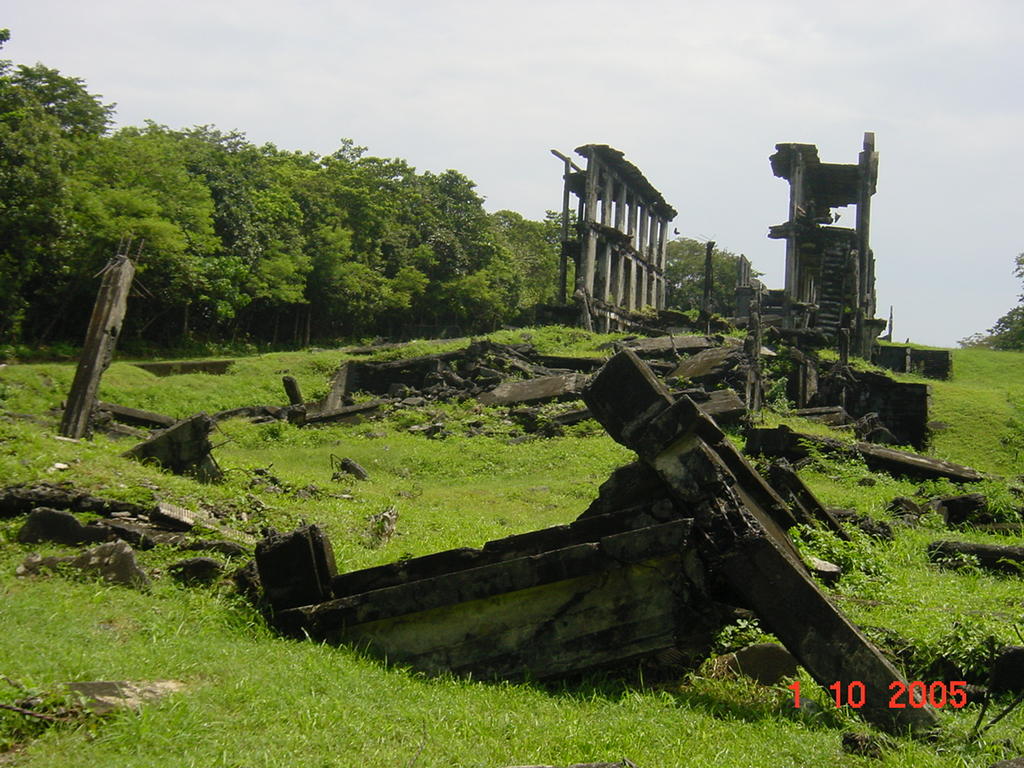 Ruins of the Mile Long Barracks on Corregidor. The portion in the foreground had served as MacArthur's office until the Japanese Air Force redesigned it as a rock garden.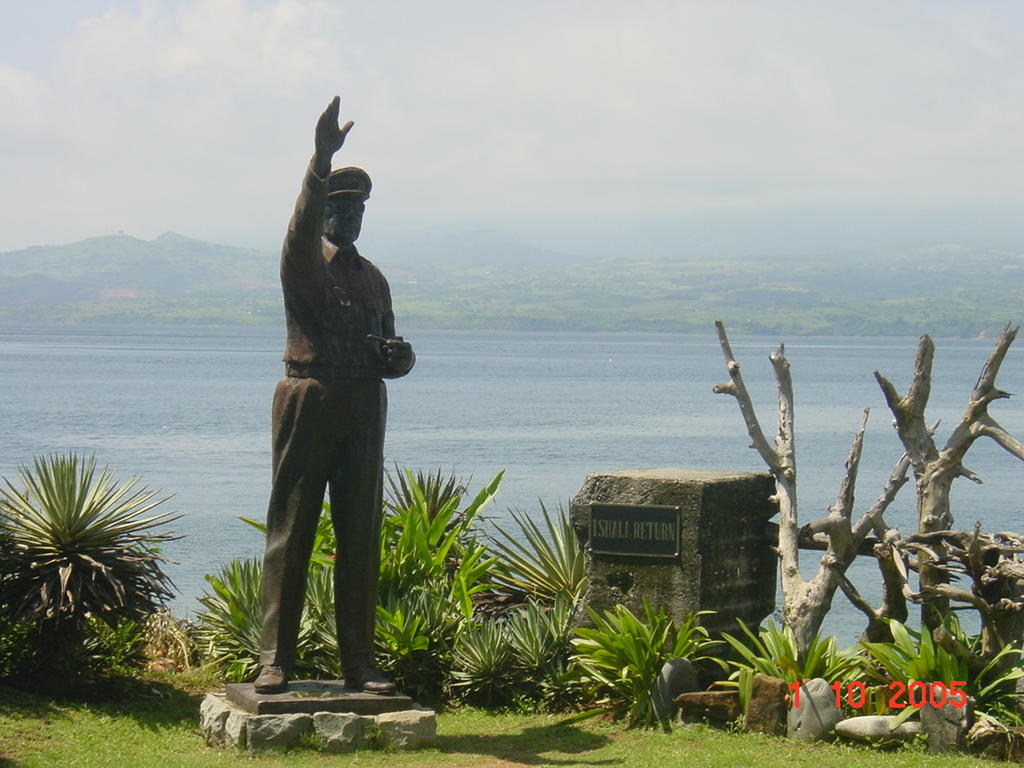
A bronze statue of the late American Caesar, General Douglas MacArthur, on a bluff above the beach at Corregidor, the island fortress he commanded at the mouth of Manila Bay. Across the water behind him is the Bataan Peninsula. His famous motto, "I shall return," is inscribed on the stone block to his left. The guns of Corregidor delayed the Japanese conquest of the Philippines for nearly six months at the beginning of American involvement in WWII. Less than three years later, early in 1945, MacArthur did return to Corregidor in preparation for the Battle of Manila.
MacArthur's father, Arthur MacArthur Jr., still in his teens, served in the 24th Wisconsin Volunteer Infantry Regiment during the Civil War and won a Congressional Medal of Honor leading a charge up Missionary Ridge in the Battle of Lookout Mountain in Tennessee. Thirty-five years later he commanded an army unit that took possession of Manila in the Pacific theatre of the Spanish-American War. The 24th was one of only a handful of regiments that trained at Camp Sigel in Milwaukee. Others included the 9th, the 26th, the 27th and the 45th. The 26th was nearly all German and served along with the 24th at Missionary Ridge. Arthur MacArthur died from a heart attack in 1912 while attending the 50th reunion of the 24th in Milwaukee.
MacArthur's grandfather, Arthur MacArthur Sr. , was a lawyer in Milwaukee. He was elected lieutenant governor in 1856, but served as governor while the outcome of the gubernatorial election was in dispute. After the Civil War he served as a federal judge in Washington D.C.. The governor of Wisconsin who was elected in 1862 drowned shortly after taking office while surveying Union casualties at Shiloh in Tennessee. His term was served out by a German, Edward Salomon, whose brothers, Charles and Frederick, both commanded Wisconsin regiments during the war.
My great great grandfather died serving in the 27th Wisconsin Volunteer Infantry Regiment, commanded by Konrad Krez, a prominent German lawyer and poet from Sheboygan. Krez also commanded the 28th Wisconsin at the brigade level in the latter stages of the war.
The pictures above were taken yesterday on my second visit to Corregidor. My first visit there was five years ago shortly after I arrived in Manila. On a clear day I can look out over Manila Bay from my living room and see "the Rock" thirty miles away on the horizon.
I don't think I'm responsible for the spam barrage in the comments below.
Sunday, September 18, 2005
You Have Mail
Two e-mails came in this week from people who found my blog and webpage while searching online for their ancestors.
I heard from a great great grandson of the Reverend Alonzo Miller, a man who served in Company B of the 27th Wisconsin. One or more of my posts had mentioned the letters Alonzo exchanged with his wife, Mary, during his one year stint as a replacement with the Union Army in the last year of the war. I had a look at a few of the letters when I visited Milwaukee in June this year. The descendant still hasn't seen them, but vows that someday he will.
My great great grandfather served in Company F of the 27th. Both he and the reverend signed on as replacements in October, 1864. They underwent training together at Camp Sigel in Milwaukee, and no doubt rode on the same train down to Little Rock to join up with their regiment early in 1865. They took a boat from there down the Mississippi to a part of New Orleans called Algiers, directly across the river from the French Quarter, where they made camp for about a week before sailing across Lake Pontchartrain and transferring to another boat that took them along the Gulf coast beyond Mobile Bay to a spot near Pensacola on the Florida panhandle. Then they marched overland to their assigned positions along the Tombigbee River where they laid siege to the rebel armories at Fort Blakely and Spanish Fort, the last major battles of the Civil War. Upwards of fifty infantry regiments from nearly a dozen different states took part in that siege. After the battle the men in that unit spent more than a month in Mobile and in New Orleans, enjoying a little southern hospitality, before they were shipped to Brazos Santiago in June to take possession of Brownsville, Texas on the Rio Grande. I'm told that one of the delicacies served to the good reverend at the home of a fine southern lady was actually rat poison. Apparently the portions were so generous they didn't stay down.
The other e-mail was from a woman in Australia whose maiden name, Lubach, is also my surname. Her great great grandfather emigrated to Queensland in 1877 at the age of 56. He had lived in a village in Germany less than thirty miles from the village where my great great grandfather lived before emigrating to Wisconsin in 1856. Could they have been cousins or perhaps even brothers? Her ancestor was about six years older than mine. Her great grandfather also emigrated to Queensland in 1877. He was born in 1850 and died in 1950 at the age of 100. Would his recollections of childhood in the old country have included an uncle and some cousins who moved to America when he was about six years old? I guess that remains to be seen.
I heard from a great great grandson of the Reverend Alonzo Miller, a man who served in Company B of the 27th Wisconsin. One or more of my posts had mentioned the letters Alonzo exchanged with his wife, Mary, during his one year stint as a replacement with the Union Army in the last year of the war. I had a look at a few of the letters when I visited Milwaukee in June this year. The descendant still hasn't seen them, but vows that someday he will.
My great great grandfather served in Company F of the 27th. Both he and the reverend signed on as replacements in October, 1864. They underwent training together at Camp Sigel in Milwaukee, and no doubt rode on the same train down to Little Rock to join up with their regiment early in 1865. They took a boat from there down the Mississippi to a part of New Orleans called Algiers, directly across the river from the French Quarter, where they made camp for about a week before sailing across Lake Pontchartrain and transferring to another boat that took them along the Gulf coast beyond Mobile Bay to a spot near Pensacola on the Florida panhandle. Then they marched overland to their assigned positions along the Tombigbee River where they laid siege to the rebel armories at Fort Blakely and Spanish Fort, the last major battles of the Civil War. Upwards of fifty infantry regiments from nearly a dozen different states took part in that siege. After the battle the men in that unit spent more than a month in Mobile and in New Orleans, enjoying a little southern hospitality, before they were shipped to Brazos Santiago in June to take possession of Brownsville, Texas on the Rio Grande. I'm told that one of the delicacies served to the good reverend at the home of a fine southern lady was actually rat poison. Apparently the portions were so generous they didn't stay down.
The other e-mail was from a woman in Australia whose maiden name, Lubach, is also my surname. Her great great grandfather emigrated to Queensland in 1877 at the age of 56. He had lived in a village in Germany less than thirty miles from the village where my great great grandfather lived before emigrating to Wisconsin in 1856. Could they have been cousins or perhaps even brothers? Her ancestor was about six years older than mine. Her great grandfather also emigrated to Queensland in 1877. He was born in 1850 and died in 1950 at the age of 100. Would his recollections of childhood in the old country have included an uncle and some cousins who moved to America when he was about six years old? I guess that remains to be seen.
Sunday, September 11, 2005
LaCharrette Village
Several months ago I got an e-mail from a visitor to my webpage. The visitor left a short message along with a link to a blog that he had just started. It only had one or two posts at that point, which generally outlined what he had planned for his blog. And I got the impression then that the "success" of my blog had at least to some degree inspired him to try his hand at blogging.
After three months he has now added a number of posts and he's adhered fairly well to the idea he originally outlined. I had offered him some encouragement in my reply and a suggestion or two, along with noting that he had something of an advantage on me in that he had already written and published the book about which he planned to blog. I've now added his blog to my blogroll. I suppose the only real connection between my blog and LaCharrette Village is that my great great grandfather had the misfortune to die in the Civil War and is buried near St. Louis.
LaCharrette Village was located a few miles up the Missouri River between St. Louis and Kansas City. It was the hometown of my fellow blogger, Lowell Schake, and, while it still existed, it was the oldest continuous European settlement in the U.S. west of the Mississippi, dating back to the middle of the 17th century or earlier. Actually, I'm a little skeptical about that claim. My understanding is that several small settlements along the upper Rio Grande in what is now New Mexico were founded by Spanish soldiers who accompanied the conquistadors, Cortez and Coronado, in the 16th century.
Even so, what has made LaCharrette a roadside attraction in recent years is it's unique location and the records Lowell Schake has found of visits to that site by explorers and frontiersmen whose status has since become legendary, if not mythic. We don't get to watch PBS out here in Manila, but apparently the 200th anniversary of the Lewis and Clark Expedition has put LaCharrette back on the map, at least temporarily.
By 1860 quite a few people were living west of St. Louis in Missouri, many of them Germans. When the Civil War began in 1861 the military engagements that took place were small and usually confined to only a few limited areas, in part because the U.S. only had one army at that time. The war had been going for nearly nine months before many of America's professional soldiers had even decided on which side they would fight. The Missouri Valley west of St. Louis was one of the Civil War's major flash points. Visitors to my webpage will find links to some of the Germans in Missouri who took an active part in these early skirmishes, ensuring that both North and South had reasons to mobilize.
After three months he has now added a number of posts and he's adhered fairly well to the idea he originally outlined. I had offered him some encouragement in my reply and a suggestion or two, along with noting that he had something of an advantage on me in that he had already written and published the book about which he planned to blog. I've now added his blog to my blogroll. I suppose the only real connection between my blog and LaCharrette Village is that my great great grandfather had the misfortune to die in the Civil War and is buried near St. Louis.
LaCharrette Village was located a few miles up the Missouri River between St. Louis and Kansas City. It was the hometown of my fellow blogger, Lowell Schake, and, while it still existed, it was the oldest continuous European settlement in the U.S. west of the Mississippi, dating back to the middle of the 17th century or earlier. Actually, I'm a little skeptical about that claim. My understanding is that several small settlements along the upper Rio Grande in what is now New Mexico were founded by Spanish soldiers who accompanied the conquistadors, Cortez and Coronado, in the 16th century.
Even so, what has made LaCharrette a roadside attraction in recent years is it's unique location and the records Lowell Schake has found of visits to that site by explorers and frontiersmen whose status has since become legendary, if not mythic. We don't get to watch PBS out here in Manila, but apparently the 200th anniversary of the Lewis and Clark Expedition has put LaCharrette back on the map, at least temporarily.
By 1860 quite a few people were living west of St. Louis in Missouri, many of them Germans. When the Civil War began in 1861 the military engagements that took place were small and usually confined to only a few limited areas, in part because the U.S. only had one army at that time. The war had been going for nearly nine months before many of America's professional soldiers had even decided on which side they would fight. The Missouri Valley west of St. Louis was one of the Civil War's major flash points. Visitors to my webpage will find links to some of the Germans in Missouri who took an active part in these early skirmishes, ensuring that both North and South had reasons to mobilize.
Sunday, September 04, 2005
News From Chippewa
I haven't seen it yet, but I'm told that my dad on the west coast received a packet of papers last week from his sister in Wisconsin, including some genealogical records, a few obits and some news clippings she's collected over the years.
I haven't actually seen these items and probably won't for awhile, but there is some interesting news. I had known that my great grandfather died young at the age of forty-one and that it seemed to be unanticipated, as his youngest child was born several months after he died, but I hadn't ever heard anything about how or why he died. One of the clippings sent was an obituary, indicating that he was killed while operating heavy machinery at the sawmill or planing mill where he worked at that time. I don't have the exact quotation, but apparently he was struck by a chunk of wood flung out by a piece of machinery in an industrial accident.
Condolences aren't obligatory here. After all, it happened a hundred and eight years ago, fifty-six years before I was born. I'm sure the event triggered terrible grief at the time, as he had a wife, five children, and a sixth on the way. But by the time I was born the shock had worn off. I suppose that the reason I am intrigued by this news is that my father is still chugging along fairly well these days, several years past normal life expectancy. Until I came along, no one in my line of descent had yet reached puberty with a father still alive. Or at least if they did, the last time it happened was fifty years before the eruption of Mt. Krakatoa.
So I guess the point of all this is that in my family there are no long standing traditions for looking after your father in his declining years. But I figure that if I go back far enough I may yet find some precedents. I was able to obtain the name of my great grandmother's father, Johann Boettcher, who came to Wisconsin in 1856, and those of his parents, Christian and Caroline Boettcher, who apparently remained behind in Pomerania instead of emigrating to America.
It seems both my father and my grandfather were named after Johann Boettcher, a man who was still alive in 1924 at the age of 94. He moved to Chippewa County during the Civil War and lived there for more than sixty years.
I haven't actually seen these items and probably won't for awhile, but there is some interesting news. I had known that my great grandfather died young at the age of forty-one and that it seemed to be unanticipated, as his youngest child was born several months after he died, but I hadn't ever heard anything about how or why he died. One of the clippings sent was an obituary, indicating that he was killed while operating heavy machinery at the sawmill or planing mill where he worked at that time. I don't have the exact quotation, but apparently he was struck by a chunk of wood flung out by a piece of machinery in an industrial accident.
Condolences aren't obligatory here. After all, it happened a hundred and eight years ago, fifty-six years before I was born. I'm sure the event triggered terrible grief at the time, as he had a wife, five children, and a sixth on the way. But by the time I was born the shock had worn off. I suppose that the reason I am intrigued by this news is that my father is still chugging along fairly well these days, several years past normal life expectancy. Until I came along, no one in my line of descent had yet reached puberty with a father still alive. Or at least if they did, the last time it happened was fifty years before the eruption of Mt. Krakatoa.
So I guess the point of all this is that in my family there are no long standing traditions for looking after your father in his declining years. But I figure that if I go back far enough I may yet find some precedents. I was able to obtain the name of my great grandmother's father, Johann Boettcher, who came to Wisconsin in 1856, and those of his parents, Christian and Caroline Boettcher, who apparently remained behind in Pomerania instead of emigrating to America.
It seems both my father and my grandfather were named after Johann Boettcher, a man who was still alive in 1924 at the age of 94. He moved to Chippewa County during the Civil War and lived there for more than sixty years.
Sunday, August 21, 2005
Old Main
I mention on my webpage that my grandfather was only 13 when his father died. The family apparently sold the homestead in Tilden and moved to nearby Chippewa Falls where my grandfather dropped out of school and worked at a sawmill for the next ten years. I point out that he wasn't listed on the 1910 census for Chippewa because in 1910 he was in Illinois attending classes at the seminary that ordained him as a minister in 1915.
A few days ago I found a website online that provides an "unauthorized history" of that "seminary" and the small liberal arts college that grew up around it. It was located in Naperville, Illinois, and according to the official history of the college it wasn't referred to as a seminary then. It was an institute known as the Evangelical Biblical Union, run by the old Evangelical Association which consisted of people who had a limited tolerance for seminaries and seminarians.
A portion of the Association eventually merged with the United Brethren and later with the Methodist Church to become United Methodists, and what was left of the Biblical Union, as I understand it, was swallowed up by the seminary at Northwestern University on the lakeshore in Chicago. But the liberal arts college, North Central, is still there in Naperville. My parents both attended that college and that's where they met. All four of my grandparents went to school there and that's where they met. My mother's brother went to school there, as did both of my dad's sisters and their husbands.
The "unauthorized history" of that college was put together by a real estate agent/genealogist in Atlanta, Georgia, named Pat Sabin, a woman whose ancestors settled in Plainfield and Naperville during the Blackhawk War of 1832 when Abraham Lincoln and Jefferson Davis were both junior officers in the same unit, chasing Chief Blackhawk all over northern Illinois and southern Wisconsin until they finally drove him across the Mississippi near the border between Iowa and Minnesota and slaughtered most of his band. Their successful collaboration at that time was considered one of the crowning achievements of the movement known as Jacksonian Democracy.
The Evangelical Biblical Union was established in 1860 in Plainfield near Joliet, Illinois, a city immortalized by Dan Akroyd and John Belushi in a movie called the Blues Brothers. Shortly after Lincoln and Davis settled their differences the Union moved a few miles north to nearby Naperville where Old Main was built when Northwestern College was established. The name apparently changed eventually to North Central to avoid confusion with Northwestern University on the shore of Lake Michigan.
The Sabin site shows the names of all of the school's graduates from 1860 until the turn of the century and has profiles of all of the early faculty members and administrators. Through 1877 the school conferred degrees on less than ten graduates each year and until the turn of the century fewer than twenty students graduated annually. One of the more interesting features of the school is that it was co-educational from its inception for both its faculty and students. The first president of the college, the Reverend Augustine Smith, had previously taught at Oberlin College in Ohio and was married to a woman, Elizabeth Cowles, whose family helped to establish that school in 1833.
One of the students at Northwestern College kept a diary during his student years. The transcription of it includes several entries with a short description in 1871 of the Great Chicago Fire, viewed from a distance of nearly thirty miles.
A few days ago I found a website online that provides an "unauthorized history" of that "seminary" and the small liberal arts college that grew up around it. It was located in Naperville, Illinois, and according to the official history of the college it wasn't referred to as a seminary then. It was an institute known as the Evangelical Biblical Union, run by the old Evangelical Association which consisted of people who had a limited tolerance for seminaries and seminarians.
A portion of the Association eventually merged with the United Brethren and later with the Methodist Church to become United Methodists, and what was left of the Biblical Union, as I understand it, was swallowed up by the seminary at Northwestern University on the lakeshore in Chicago. But the liberal arts college, North Central, is still there in Naperville. My parents both attended that college and that's where they met. All four of my grandparents went to school there and that's where they met. My mother's brother went to school there, as did both of my dad's sisters and their husbands.
The "unauthorized history" of that college was put together by a real estate agent/genealogist in Atlanta, Georgia, named Pat Sabin, a woman whose ancestors settled in Plainfield and Naperville during the Blackhawk War of 1832 when Abraham Lincoln and Jefferson Davis were both junior officers in the same unit, chasing Chief Blackhawk all over northern Illinois and southern Wisconsin until they finally drove him across the Mississippi near the border between Iowa and Minnesota and slaughtered most of his band. Their successful collaboration at that time was considered one of the crowning achievements of the movement known as Jacksonian Democracy.
The Evangelical Biblical Union was established in 1860 in Plainfield near Joliet, Illinois, a city immortalized by Dan Akroyd and John Belushi in a movie called the Blues Brothers. Shortly after Lincoln and Davis settled their differences the Union moved a few miles north to nearby Naperville where Old Main was built when Northwestern College was established. The name apparently changed eventually to North Central to avoid confusion with Northwestern University on the shore of Lake Michigan.
The Sabin site shows the names of all of the school's graduates from 1860 until the turn of the century and has profiles of all of the early faculty members and administrators. Through 1877 the school conferred degrees on less than ten graduates each year and until the turn of the century fewer than twenty students graduated annually. One of the more interesting features of the school is that it was co-educational from its inception for both its faculty and students. The first president of the college, the Reverend Augustine Smith, had previously taught at Oberlin College in Ohio and was married to a woman, Elizabeth Cowles, whose family helped to establish that school in 1833.
One of the students at Northwestern College kept a diary during his student years. The transcription of it includes several entries with a short description in 1871 of the Great Chicago Fire, viewed from a distance of nearly thirty miles.
Sunday, August 14, 2005
Bloomer Advance
I came across a letter a few days ago concerning my great great grandfather that was published online at the end of May in the Bloomer Advance, an online edition of the community newspaper in Bloomer, Wisconsin, which is the nearest town to the Chippewa County homestead in Tilden where my great grandparents settled around 1880.
The letter was written by Vernon Kressin, whose wife, Lois, it seems, is a long lost cousin of mine. You can read his letter if you click on the link. It's only a few short paragraphs. I'm not sure exactly how I'm related to his wife, although my guess would be that she's the daughter of one of my grandfather's sisters. The letter reveals that Vernon and Lois actually visited my great great grandfather's grave at the Jefferson Barracks National Cemetery in St. Louis and that to date she is perhaps the only one of his descendants who has done so.
Vernon's letter mentions that my great great grandfather, William Lubach, fell ill with the flu while returning from the war, but that's not entirely accurate. He died and was buried on July 27th, 1865, while the rest of his unit was still stationed on the island of Brazos Santiago at the mouth of the Rio Grande, two months after the war had officially ended. His unit, the 27th Wisconsin Volunteer Infantry, marched on Brownsville on the 1st of August that year. The rebels there surrendered a few days later and the unit was mustered out of service in Brownsville during the last week of August. My guess is that my great great grandfather fell ill in July and was evacuated to the hospital at Jefferson Barracks, which was reputedly the best military hospital in the western theatre at that time. An aunt recently sent me an e-mail which suggests that he died of yellow fever.
I'm not sure exactly when Vernon and Lois made their pilgrimage to St. Louis. I think it's nice that they did, but it seems to me that it's also an indication that my family back in Wisconsin knew about my great great grandfather's Civil War service. So why is that important?
I have two brothers and three male cousins. So there are six of us capable of passing my great great grandfather's surname along to a sixth generation since his arrival in America in 1856. One of my cousins is older than I am. My youngest brother is only 36. Among us we have sired three daughters and no sons.
I guess what I am wondering is why I had to learn about this situation by putting the pieces of the puzzle together on the internet instead of hearing the news directly from my extended family. My website has been up and running for a whole year now and Vernon's letter is the first published acknowledgement I have had from any of my relatives, by blood or by marriage, that I am on the right track.
If you click on the Obituary link on the Bloomer Advance site and run down the list, you might notice that Vernon's brother, Norbert, died about a month ago at the age of 82. I assume Vernon is roughly the same age as his brother. If you are reading this, Vernon, please accept my condolences on the loss of your brother. And thank you, God bless you, in fact, for spilling the beans after all these years.
Oh, and by the way, my wife and I are celebrating our 18th wedding anniversary today. Cheers.
The letter was written by Vernon Kressin, whose wife, Lois, it seems, is a long lost cousin of mine. You can read his letter if you click on the link. It's only a few short paragraphs. I'm not sure exactly how I'm related to his wife, although my guess would be that she's the daughter of one of my grandfather's sisters. The letter reveals that Vernon and Lois actually visited my great great grandfather's grave at the Jefferson Barracks National Cemetery in St. Louis and that to date she is perhaps the only one of his descendants who has done so.
Vernon's letter mentions that my great great grandfather, William Lubach, fell ill with the flu while returning from the war, but that's not entirely accurate. He died and was buried on July 27th, 1865, while the rest of his unit was still stationed on the island of Brazos Santiago at the mouth of the Rio Grande, two months after the war had officially ended. His unit, the 27th Wisconsin Volunteer Infantry, marched on Brownsville on the 1st of August that year. The rebels there surrendered a few days later and the unit was mustered out of service in Brownsville during the last week of August. My guess is that my great great grandfather fell ill in July and was evacuated to the hospital at Jefferson Barracks, which was reputedly the best military hospital in the western theatre at that time. An aunt recently sent me an e-mail which suggests that he died of yellow fever.
I'm not sure exactly when Vernon and Lois made their pilgrimage to St. Louis. I think it's nice that they did, but it seems to me that it's also an indication that my family back in Wisconsin knew about my great great grandfather's Civil War service. So why is that important?
I have two brothers and three male cousins. So there are six of us capable of passing my great great grandfather's surname along to a sixth generation since his arrival in America in 1856. One of my cousins is older than I am. My youngest brother is only 36. Among us we have sired three daughters and no sons.
I guess what I am wondering is why I had to learn about this situation by putting the pieces of the puzzle together on the internet instead of hearing the news directly from my extended family. My website has been up and running for a whole year now and Vernon's letter is the first published acknowledgement I have had from any of my relatives, by blood or by marriage, that I am on the right track.
If you click on the Obituary link on the Bloomer Advance site and run down the list, you might notice that Vernon's brother, Norbert, died about a month ago at the age of 82. I assume Vernon is roughly the same age as his brother. If you are reading this, Vernon, please accept my condolences on the loss of your brother. And thank you, God bless you, in fact, for spilling the beans after all these years.
Oh, and by the way, my wife and I are celebrating our 18th wedding anniversary today. Cheers.
Sunday, July 24, 2005
Back Online
Home leave is over, so I can go back to blogging after a five week hiatus. I was able to get online a few times during my travels, but not long enough to put together a post. And I think it was good to get away from it for awhile, as it gave me a chance to gain some perspective and consider ways to both broaden and focus my appeal. My wife and I got together with family members and with quite a few friends in the U.S. who we rarely get to see. Even those experienced with using computers had a hard time comprehending the world of blogging.
People who read blogs are mostly people who also write them. I tend to write my posts to share information with people I already know who don't generally read blogs and in most cases don't even know what a blog is. Perhaps that will change over time, but I think I might get more response if I focus on the people who actually read my blog instead of those who I think might or should read it. Only one reader commented on my blog while I was away, but that comment was important as it came from the person who transcribed and posted online the cemetery that was the point of departure for both my webpage and my blog. I just wish her comment had included some indication of how she managed to find my blog.
I was also able to get an e-mail address and exchange e-mails with my Aunt Vera who lives in Chippewa Falls. She's eighty-eight years old and may have some recollections of some of the people buried in the Tilden cemetery along with my great grandparents. On the plane ride from Tokyo to Minneapolis I was able to translate three or four pages of the biography of my great great grandfather's commanding officer in the Civil War, the Poet-General Konrad Krez, which is a recent book, published in 1988, but written in fairly technical academic German. Sometimes plane travel can actually enhance concentration. And in Milwaukee I met my mother-in-law's next door neighbor, a retired music teacher who it turns out is also a Civil War and genealogy buff. He's good with computers and has an Ancestry.com membership which he can use to access census records I would have to pay to see.
I tried to get in touch with Lance Hertigan, a writer who has published several books on the Civil War. He has been the director of the Civil War Institute at Carroll College which I visited in Milwaukee. But that visit wasn't real productive as the Institute is currently being merged with another museum in Pewaukee that will be expanded to serve both Milwaukee and Chicago. I was, however, able to meet another writer a few weeks later in Seattle, Andrew Ward, who told me that his next book, already in progress, will be about an incident from the Civil War.
I spent an afternoon at the Golda Meir Library at the University of Wisconsin Milwaukee Campus. I had an hour or two to look at a collection of letters exchanged between the Reverend Alonzo Miller and his wife during the Civil War while he was serving in my great great granfather's regiment, the 27th Wisconsin Infantry. I made photocopies of some of the letters, and I'll be able to read the parts that are easily legible. Much of the handwriting though is in faded ink and will require close perusal with a magnifying glass and two or three weeks of daily access to the originals to decipher. One thing I did learn is that the unit didn't march on Brownsville until several days after my great great grandfather died, so it's clear that he wasn't done in by the rigors of that march.
My home leave visit two years ago resulted in a terrific and unexpected breakthrough which provided enough information so that I felt a need to pull it all together on a webpage and to start my blog as a means to continually update my findings. Nothing on this trip really qualifies as a breakthrough in my book, but I did get a chance to check some things out and to consider different ways of moving forward on this project. I'm gaining some momentum, but it's a slow train coming.
People who read blogs are mostly people who also write them. I tend to write my posts to share information with people I already know who don't generally read blogs and in most cases don't even know what a blog is. Perhaps that will change over time, but I think I might get more response if I focus on the people who actually read my blog instead of those who I think might or should read it. Only one reader commented on my blog while I was away, but that comment was important as it came from the person who transcribed and posted online the cemetery that was the point of departure for both my webpage and my blog. I just wish her comment had included some indication of how she managed to find my blog.
I was also able to get an e-mail address and exchange e-mails with my Aunt Vera who lives in Chippewa Falls. She's eighty-eight years old and may have some recollections of some of the people buried in the Tilden cemetery along with my great grandparents. On the plane ride from Tokyo to Minneapolis I was able to translate three or four pages of the biography of my great great grandfather's commanding officer in the Civil War, the Poet-General Konrad Krez, which is a recent book, published in 1988, but written in fairly technical academic German. Sometimes plane travel can actually enhance concentration. And in Milwaukee I met my mother-in-law's next door neighbor, a retired music teacher who it turns out is also a Civil War and genealogy buff. He's good with computers and has an Ancestry.com membership which he can use to access census records I would have to pay to see.
I tried to get in touch with Lance Hertigan, a writer who has published several books on the Civil War. He has been the director of the Civil War Institute at Carroll College which I visited in Milwaukee. But that visit wasn't real productive as the Institute is currently being merged with another museum in Pewaukee that will be expanded to serve both Milwaukee and Chicago. I was, however, able to meet another writer a few weeks later in Seattle, Andrew Ward, who told me that his next book, already in progress, will be about an incident from the Civil War.
I spent an afternoon at the Golda Meir Library at the University of Wisconsin Milwaukee Campus. I had an hour or two to look at a collection of letters exchanged between the Reverend Alonzo Miller and his wife during the Civil War while he was serving in my great great granfather's regiment, the 27th Wisconsin Infantry. I made photocopies of some of the letters, and I'll be able to read the parts that are easily legible. Much of the handwriting though is in faded ink and will require close perusal with a magnifying glass and two or three weeks of daily access to the originals to decipher. One thing I did learn is that the unit didn't march on Brownsville until several days after my great great grandfather died, so it's clear that he wasn't done in by the rigors of that march.
My home leave visit two years ago resulted in a terrific and unexpected breakthrough which provided enough information so that I felt a need to pull it all together on a webpage and to start my blog as a means to continually update my findings. Nothing on this trip really qualifies as a breakthrough in my book, but I did get a chance to check some things out and to consider different ways of moving forward on this project. I'm gaining some momentum, but it's a slow train coming.
Sunday, June 12, 2005
On The Road Again
Like a pair of gypsies we soar down the skyway. Home leave is not yet offically underway until next week as my wife has an annual meeting to attend, so we're stuck here in Hawaii on duty travel for a few days until I can get re-adjusted to driving between instead of astride the white lines, stopping at red lights, going on green and remembering that it's considered rude to enter a stream of traffic by nosing one's bumper into the path of an oncoming vehicle. The aforesaid maneuvers are all considered standard in Manila. There you can even drive the wrong way on one way streets or back up into the intersection where you had meant to turn. No harm, no foul.
The problem with home leave is that after twelve years overseas, home isn't really home anymore. It's just someplace where you used to live, a house that you still own that is occupied by tenants you've never met and probably won't; parents who, through time-lapse photography, keep getting two years older every time you see them; and friends from way back when whose toddlers, you remember, have now made their parents empty nesters . It's a full month of squeezing every one you once cared about, and always will, into molds that no longer quite fit. Catching up is more fun when it's serendipitous.
The problem with home leave is that after twelve years overseas, home isn't really home anymore. It's just someplace where you used to live, a house that you still own that is occupied by tenants you've never met and probably won't; parents who, through time-lapse photography, keep getting two years older every time you see them; and friends from way back when whose toddlers, you remember, have now made their parents empty nesters . It's a full month of squeezing every one you once cared about, and always will, into molds that no longer quite fit. Catching up is more fun when it's serendipitous.
Sunday, June 05, 2005
Nick of Time
Watching a movie on television is a little different when someone you know is in it. Last night I saw the suspense thriller 'Nick of Time' on television for the first time, not realizing until midway through that that's what it was. But by the end of the movie it became clear to me that this was the movie I had read about on the internet several years ago. I had googled it up because someone I knew was in it, an actress I met some twenty years ago, a gospel, jazz and blues vocalist who eventually won significant parts in a number of local stage productions in Seattle. I learned from the internet a few years ago that she spent much of the 90s in Los Angeles, getting bit parts in episodes of a dozen different television series and in two movies.
Her role in 'Nick of Time' was like most of her bit parts, one or two lines of dialogue and a handful of seconds or less actually on screen. It went by so fast that I wasn't able to spot her on the cable broadcast, so today I went to the video store and bought the VCD. Her line is "Here's your Jack and Coke, sir." She plays a cocktail waitress. She sets down a cocktail napkin, delivers her line and the drink, then taps her fingernail three times on the cocktail napkin. The hero, played by Johnny Depp, picks up his drink and notices, as a result of the fingertaps, a three word message written on the cocktail napkin. The information on the napkin is not just vital; it's crucial to the action and the outcome of the story. Depp's character is at a point of desperation, lapsing into despair, but the message alerts him to the fact that his plea for help has been heard and a plan is in the works that gives him hope and perhaps even a fighting chance to extricate himself from a dire situation. It's actually the turning point in the movie, the point at which his role in the movie subtly shifts from hapless victim to action hero.
Reviews for the movie when it was made ten years ago were disappointing considering the quality of the cast and the skill of the director. The story was deemed too improbable to justify ripping off Alfred Hitchcock's techniques for generating suspense. But reviews have steadily improved in recent years. Perhaps events since 9-11 have rendered a little less passe the sometimes hoky premises Hitchcock so famously and successfully exploited early on in the Cold War era.
Her role in 'Nick of Time' was like most of her bit parts, one or two lines of dialogue and a handful of seconds or less actually on screen. It went by so fast that I wasn't able to spot her on the cable broadcast, so today I went to the video store and bought the VCD. Her line is "Here's your Jack and Coke, sir." She plays a cocktail waitress. She sets down a cocktail napkin, delivers her line and the drink, then taps her fingernail three times on the cocktail napkin. The hero, played by Johnny Depp, picks up his drink and notices, as a result of the fingertaps, a three word message written on the cocktail napkin. The information on the napkin is not just vital; it's crucial to the action and the outcome of the story. Depp's character is at a point of desperation, lapsing into despair, but the message alerts him to the fact that his plea for help has been heard and a plan is in the works that gives him hope and perhaps even a fighting chance to extricate himself from a dire situation. It's actually the turning point in the movie, the point at which his role in the movie subtly shifts from hapless victim to action hero.
Reviews for the movie when it was made ten years ago were disappointing considering the quality of the cast and the skill of the director. The story was deemed too improbable to justify ripping off Alfred Hitchcock's techniques for generating suspense. But reviews have steadily improved in recent years. Perhaps events since 9-11 have rendered a little less passe the sometimes hoky premises Hitchcock so famously and successfully exploited early on in the Cold War era.
Subscribe to:
Posts (Atom)