Well, I've done it now. I finally broke down and shelled out the bucks for an Ancestry.com membership. Nearly all of the information I've accumulated and posted about my family history on my webpage in the past three years, and here on my blog in the past year, has come from the internet free of charge. So why am I now willing to part with the big bucks? Am I selling out? Do the pay sites suddenly have vital information worth more than ten dollars a month to me? I don't think so, on either count.
The main thing you get with a membership is comprehensive access to several main sets of database records, the largest and most important of these being the U.S. Federal Census Records and the Social Security Death Index. You can search these records without being a paying member; you just can't see the results. Instead all you get is an indication of the number of hits on your search item in those databases. But simply knowing that there are hits can be a very useful clue. When there are hits, the specifics can often be accessed elsewhere free of charge.
Rootsweb and U.S. GenWeb are large free database projects that make relevant portions of the federal census records and other databases available to localized free genealogy websites. Most counties in America have one or more websites that exist solely for the purpose of making records available to people whose roots are in that locality. So if you know what you are looking for and where to look for it on the web, you can usually find it. What Ancestry.com and other paysites sell is convenient and comprehensive access.
I guess what's happened to me is that I've reached the point where I've decided I don't mind paying for convenient, comprehensive access. First, I can afford it. Second, it's a worthwhile product. And third, I've reached a point where I can start to make use of some of the vast quantity of information that is related less specifically to my particular ancestors. Comprehensive access allows you to make better generalizations based on peripheral data.
I'm fortunate to have at least one fairly distinctive surname to trace. My last name is not one that you encounter everyday. If you were to canvas all of the phone books in America, you would find fewer people with my surname than you would find listed under Smith or Jones in any one small town in America. And with only a few hundred or perhaps one or two thousand total listings to draw on, it's not that hard to eliminate those that are probably not directly related to me.
While the items that I have found and posted on my webpage are not necessarily always the proverbial "smoking gun" of definitive proof, they are often enough sufficient evidence on which to base an assumption or a supposition. And when a supposition leads directly or even indirectly to a subsequent find, it indicates something about the validity of that supposition.
Now for something completely unrelated, I've added another reciprocal link to my blogroll.
In a Dark Time features some terrific wildlife photography and some excellent commentary and personal reflections on poems by many of the most significant modern American poets of the past century. I include it here because of the entries on Theodore Roethke and Nelson Bentley.
Sunday, October 16, 2005

Sunday, October 02, 2005
"I Shall Return"
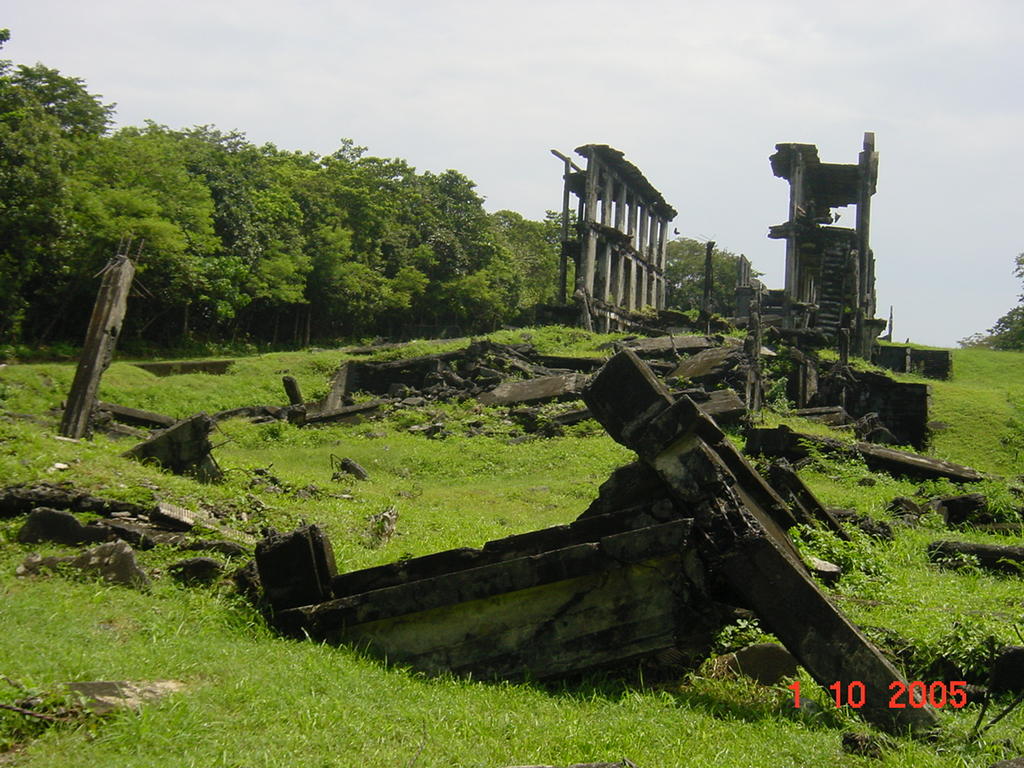 Ruins of the Mile Long Barracks on Corregidor. The portion in the foreground had served as MacArthur's office until the Japanese Air Force redesigned it as a rock garden.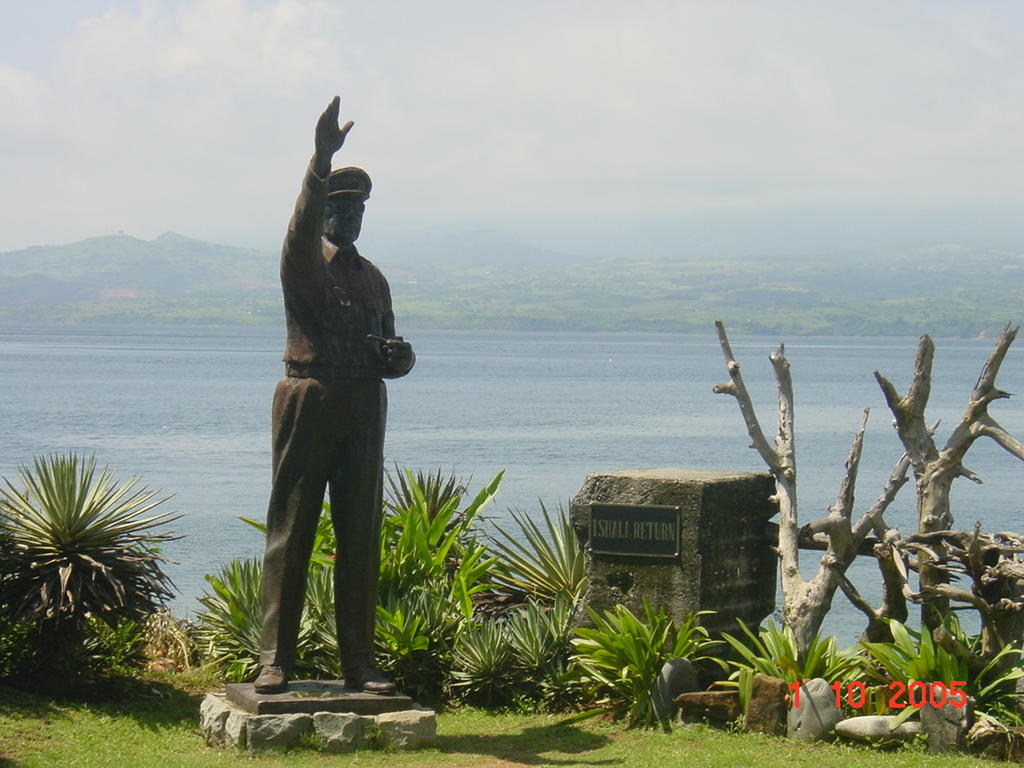
A bronze statue of the late American Caesar, General Douglas MacArthur, on a bluff above the beach at Corregidor, the island fortress he commanded at the mouth of Manila Bay. Across the water behind him is the Bataan Peninsula. His famous motto, "I shall return," is inscribed on the stone block to his left. The guns of Corregidor delayed the Japanese conquest of the Philippines for nearly six months at the beginning of American involvement in WWII. Less than three years later, early in 1945, MacArthur did return to Corregidor in preparation for the Battle of Manila.
MacArthur's father, Arthur MacArthur Jr., still in his teens, served in the 24th Wisconsin Volunteer Infantry Regiment during the Civil War and won a Congressional Medal of Honor leading a charge up Missionary Ridge in the Battle of Lookout Mountain in Tennessee. Thirty-five years later he commanded an army unit that took possession of Manila in the Pacific theatre of the Spanish-American War. The 24th was one of only a handful of regiments that trained at Camp Sigel in Milwaukee. Others included the 9th, the 26th, the 27th and the 45th. The 26th was nearly all German and served along with the 24th at Missionary Ridge. Arthur MacArthur died from a heart attack in 1912 while attending the 50th reunion of the 24th in Milwaukee.
MacArthur's grandfather, Arthur MacArthur Sr. , was a lawyer in Milwaukee. He was elected lieutenant governor in 1856, but served as governor while the outcome of the gubernatorial election was in dispute. After the Civil War he served as a federal judge in Washington D.C.. The governor of Wisconsin who was elected in 1862 drowned shortly after taking office while surveying Union casualties at Shiloh in Tennessee. His term was served out by a German, Edward Salomon, whose brothers, Charles and Frederick, both commanded Wisconsin regiments during the war.
My great great grandfather died serving in the 27th Wisconsin Volunteer Infantry Regiment, commanded by Konrad Krez, a prominent German lawyer and poet from Sheboygan. Krez also commanded the 28th Wisconsin at the brigade level in the latter stages of the war.
The pictures above were taken yesterday on my second visit to Corregidor. My first visit there was five years ago shortly after I arrived in Manila. On a clear day I can look out over Manila Bay from my living room and see "the Rock" thirty miles away on the horizon.
I don't think I'm responsible for the spam barrage in the comments below.
Sunday, September 18, 2005
You Have Mail
Two e-mails came in this week from people who found my blog and webpage while searching online for their ancestors.
I heard from a great great grandson of the Reverend Alonzo Miller, a man who served in Company B of the 27th Wisconsin. One or more of my posts had mentioned the letters Alonzo exchanged with his wife, Mary, during his one year stint as a replacement with the Union Army in the last year of the war. I had a look at a few of the letters when I visited Milwaukee in June this year. The descendant still hasn't seen them, but vows that someday he will.
My great great grandfather served in Company F of the 27th. Both he and the reverend signed on as replacements in October, 1864. They underwent training together at Camp Sigel in Milwaukee, and no doubt rode on the same train down to Little Rock to join up with their regiment early in 1865. They took a boat from there down the Mississippi to a part of New Orleans called Algiers, directly across the river from the French Quarter, where they made camp for about a week before sailing across Lake Pontchartrain and transferring to another boat that took them along the Gulf coast beyond Mobile Bay to a spot near Pensacola on the Florida panhandle. Then they marched overland to their assigned positions along the Tombigbee River where they laid siege to the rebel armories at Fort Blakely and Spanish Fort, the last major battles of the Civil War. Upwards of fifty infantry regiments from nearly a dozen different states took part in that siege. After the battle the men in that unit spent more than a month in Mobile and in New Orleans, enjoying a little southern hospitality, before they were shipped to Brazos Santiago in June to take possession of Brownsville, Texas on the Rio Grande. I'm told that one of the delicacies served to the good reverend at the home of a fine southern lady was actually rat poison. Apparently the portions were so generous they didn't stay down.
The other e-mail was from a woman in Australia whose maiden name, Lubach, is also my surname. Her great great grandfather emigrated to Queensland in 1877 at the age of 56. He had lived in a village in Germany less than thirty miles from the village where my great great grandfather lived before emigrating to Wisconsin in 1856. Could they have been cousins or perhaps even brothers? Her ancestor was about six years older than mine. Her great grandfather also emigrated to Queensland in 1877. He was born in 1850 and died in 1950 at the age of 100. Would his recollections of childhood in the old country have included an uncle and some cousins who moved to America when he was about six years old? I guess that remains to be seen.
I heard from a great great grandson of the Reverend Alonzo Miller, a man who served in Company B of the 27th Wisconsin. One or more of my posts had mentioned the letters Alonzo exchanged with his wife, Mary, during his one year stint as a replacement with the Union Army in the last year of the war. I had a look at a few of the letters when I visited Milwaukee in June this year. The descendant still hasn't seen them, but vows that someday he will.
My great great grandfather served in Company F of the 27th. Both he and the reverend signed on as replacements in October, 1864. They underwent training together at Camp Sigel in Milwaukee, and no doubt rode on the same train down to Little Rock to join up with their regiment early in 1865. They took a boat from there down the Mississippi to a part of New Orleans called Algiers, directly across the river from the French Quarter, where they made camp for about a week before sailing across Lake Pontchartrain and transferring to another boat that took them along the Gulf coast beyond Mobile Bay to a spot near Pensacola on the Florida panhandle. Then they marched overland to their assigned positions along the Tombigbee River where they laid siege to the rebel armories at Fort Blakely and Spanish Fort, the last major battles of the Civil War. Upwards of fifty infantry regiments from nearly a dozen different states took part in that siege. After the battle the men in that unit spent more than a month in Mobile and in New Orleans, enjoying a little southern hospitality, before they were shipped to Brazos Santiago in June to take possession of Brownsville, Texas on the Rio Grande. I'm told that one of the delicacies served to the good reverend at the home of a fine southern lady was actually rat poison. Apparently the portions were so generous they didn't stay down.
The other e-mail was from a woman in Australia whose maiden name, Lubach, is also my surname. Her great great grandfather emigrated to Queensland in 1877 at the age of 56. He had lived in a village in Germany less than thirty miles from the village where my great great grandfather lived before emigrating to Wisconsin in 1856. Could they have been cousins or perhaps even brothers? Her ancestor was about six years older than mine. Her great grandfather also emigrated to Queensland in 1877. He was born in 1850 and died in 1950 at the age of 100. Would his recollections of childhood in the old country have included an uncle and some cousins who moved to America when he was about six years old? I guess that remains to be seen.
Sunday, September 11, 2005
LaCharrette Village
Several months ago I got an e-mail from a visitor to my webpage. The visitor left a short message along with a link to a blog that he had just started. It only had one or two posts at that point, which generally outlined what he had planned for his blog. And I got the impression then that the "success" of my blog had at least to some degree inspired him to try his hand at blogging.
After three months he has now added a number of posts and he's adhered fairly well to the idea he originally outlined. I had offered him some encouragement in my reply and a suggestion or two, along with noting that he had something of an advantage on me in that he had already written and published the book about which he planned to blog. I've now added his blog to my blogroll. I suppose the only real connection between my blog and LaCharrette Village is that my great great grandfather had the misfortune to die in the Civil War and is buried near St. Louis.
LaCharrette Village was located a few miles up the Missouri River between St. Louis and Kansas City. It was the hometown of my fellow blogger, Lowell Schake, and, while it still existed, it was the oldest continuous European settlement in the U.S. west of the Mississippi, dating back to the middle of the 17th century or earlier. Actually, I'm a little skeptical about that claim. My understanding is that several small settlements along the upper Rio Grande in what is now New Mexico were founded by Spanish soldiers who accompanied the conquistadors, Cortez and Coronado, in the 16th century.
Even so, what has made LaCharrette a roadside attraction in recent years is it's unique location and the records Lowell Schake has found of visits to that site by explorers and frontiersmen whose status has since become legendary, if not mythic. We don't get to watch PBS out here in Manila, but apparently the 200th anniversary of the Lewis and Clark Expedition has put LaCharrette back on the map, at least temporarily.
By 1860 quite a few people were living west of St. Louis in Missouri, many of them Germans. When the Civil War began in 1861 the military engagements that took place were small and usually confined to only a few limited areas, in part because the U.S. only had one army at that time. The war had been going for nearly nine months before many of America's professional soldiers had even decided on which side they would fight. The Missouri Valley west of St. Louis was one of the Civil War's major flash points. Visitors to my webpage will find links to some of the Germans in Missouri who took an active part in these early skirmishes, ensuring that both North and South had reasons to mobilize.
After three months he has now added a number of posts and he's adhered fairly well to the idea he originally outlined. I had offered him some encouragement in my reply and a suggestion or two, along with noting that he had something of an advantage on me in that he had already written and published the book about which he planned to blog. I've now added his blog to my blogroll. I suppose the only real connection between my blog and LaCharrette Village is that my great great grandfather had the misfortune to die in the Civil War and is buried near St. Louis.
LaCharrette Village was located a few miles up the Missouri River between St. Louis and Kansas City. It was the hometown of my fellow blogger, Lowell Schake, and, while it still existed, it was the oldest continuous European settlement in the U.S. west of the Mississippi, dating back to the middle of the 17th century or earlier. Actually, I'm a little skeptical about that claim. My understanding is that several small settlements along the upper Rio Grande in what is now New Mexico were founded by Spanish soldiers who accompanied the conquistadors, Cortez and Coronado, in the 16th century.
Even so, what has made LaCharrette a roadside attraction in recent years is it's unique location and the records Lowell Schake has found of visits to that site by explorers and frontiersmen whose status has since become legendary, if not mythic. We don't get to watch PBS out here in Manila, but apparently the 200th anniversary of the Lewis and Clark Expedition has put LaCharrette back on the map, at least temporarily.
By 1860 quite a few people were living west of St. Louis in Missouri, many of them Germans. When the Civil War began in 1861 the military engagements that took place were small and usually confined to only a few limited areas, in part because the U.S. only had one army at that time. The war had been going for nearly nine months before many of America's professional soldiers had even decided on which side they would fight. The Missouri Valley west of St. Louis was one of the Civil War's major flash points. Visitors to my webpage will find links to some of the Germans in Missouri who took an active part in these early skirmishes, ensuring that both North and South had reasons to mobilize.
Sunday, September 04, 2005
News From Chippewa
I haven't seen it yet, but I'm told that my dad on the west coast received a packet of papers last week from his sister in Wisconsin, including some genealogical records, a few obits and some news clippings she's collected over the years.
I haven't actually seen these items and probably won't for awhile, but there is some interesting news. I had known that my great grandfather died young at the age of forty-one and that it seemed to be unanticipated, as his youngest child was born several months after he died, but I hadn't ever heard anything about how or why he died. One of the clippings sent was an obituary, indicating that he was killed while operating heavy machinery at the sawmill or planing mill where he worked at that time. I don't have the exact quotation, but apparently he was struck by a chunk of wood flung out by a piece of machinery in an industrial accident.
Condolences aren't obligatory here. After all, it happened a hundred and eight years ago, fifty-six years before I was born. I'm sure the event triggered terrible grief at the time, as he had a wife, five children, and a sixth on the way. But by the time I was born the shock had worn off. I suppose that the reason I am intrigued by this news is that my father is still chugging along fairly well these days, several years past normal life expectancy. Until I came along, no one in my line of descent had yet reached puberty with a father still alive. Or at least if they did, the last time it happened was fifty years before the eruption of Mt. Krakatoa.
So I guess the point of all this is that in my family there are no long standing traditions for looking after your father in his declining years. But I figure that if I go back far enough I may yet find some precedents. I was able to obtain the name of my great grandmother's father, Johann Boettcher, who came to Wisconsin in 1856, and those of his parents, Christian and Caroline Boettcher, who apparently remained behind in Pomerania instead of emigrating to America.
It seems both my father and my grandfather were named after Johann Boettcher, a man who was still alive in 1924 at the age of 94. He moved to Chippewa County during the Civil War and lived there for more than sixty years.
I haven't actually seen these items and probably won't for awhile, but there is some interesting news. I had known that my great grandfather died young at the age of forty-one and that it seemed to be unanticipated, as his youngest child was born several months after he died, but I hadn't ever heard anything about how or why he died. One of the clippings sent was an obituary, indicating that he was killed while operating heavy machinery at the sawmill or planing mill where he worked at that time. I don't have the exact quotation, but apparently he was struck by a chunk of wood flung out by a piece of machinery in an industrial accident.
Condolences aren't obligatory here. After all, it happened a hundred and eight years ago, fifty-six years before I was born. I'm sure the event triggered terrible grief at the time, as he had a wife, five children, and a sixth on the way. But by the time I was born the shock had worn off. I suppose that the reason I am intrigued by this news is that my father is still chugging along fairly well these days, several years past normal life expectancy. Until I came along, no one in my line of descent had yet reached puberty with a father still alive. Or at least if they did, the last time it happened was fifty years before the eruption of Mt. Krakatoa.
So I guess the point of all this is that in my family there are no long standing traditions for looking after your father in his declining years. But I figure that if I go back far enough I may yet find some precedents. I was able to obtain the name of my great grandmother's father, Johann Boettcher, who came to Wisconsin in 1856, and those of his parents, Christian and Caroline Boettcher, who apparently remained behind in Pomerania instead of emigrating to America.
It seems both my father and my grandfather were named after Johann Boettcher, a man who was still alive in 1924 at the age of 94. He moved to Chippewa County during the Civil War and lived there for more than sixty years.
Sunday, August 21, 2005
Old Main
I mention on my webpage that my grandfather was only 13 when his father died. The family apparently sold the homestead in Tilden and moved to nearby Chippewa Falls where my grandfather dropped out of school and worked at a sawmill for the next ten years. I point out that he wasn't listed on the 1910 census for Chippewa because in 1910 he was in Illinois attending classes at the seminary that ordained him as a minister in 1915.
A few days ago I found a website online that provides an "unauthorized history" of that "seminary" and the small liberal arts college that grew up around it. It was located in Naperville, Illinois, and according to the official history of the college it wasn't referred to as a seminary then. It was an institute known as the Evangelical Biblical Union, run by the old Evangelical Association which consisted of people who had a limited tolerance for seminaries and seminarians.
A portion of the Association eventually merged with the United Brethren and later with the Methodist Church to become United Methodists, and what was left of the Biblical Union, as I understand it, was swallowed up by the seminary at Northwestern University on the lakeshore in Chicago. But the liberal arts college, North Central, is still there in Naperville. My parents both attended that college and that's where they met. All four of my grandparents went to school there and that's where they met. My mother's brother went to school there, as did both of my dad's sisters and their husbands.
The "unauthorized history" of that college was put together by a real estate agent/genealogist in Atlanta, Georgia, named Pat Sabin, a woman whose ancestors settled in Plainfield and Naperville during the Blackhawk War of 1832 when Abraham Lincoln and Jefferson Davis were both junior officers in the same unit, chasing Chief Blackhawk all over northern Illinois and southern Wisconsin until they finally drove him across the Mississippi near the border between Iowa and Minnesota and slaughtered most of his band. Their successful collaboration at that time was considered one of the crowning achievements of the movement known as Jacksonian Democracy.
The Evangelical Biblical Union was established in 1860 in Plainfield near Joliet, Illinois, a city immortalized by Dan Akroyd and John Belushi in a movie called the Blues Brothers. Shortly after Lincoln and Davis settled their differences the Union moved a few miles north to nearby Naperville where Old Main was built when Northwestern College was established. The name apparently changed eventually to North Central to avoid confusion with Northwestern University on the shore of Lake Michigan.
The Sabin site shows the names of all of the school's graduates from 1860 until the turn of the century and has profiles of all of the early faculty members and administrators. Through 1877 the school conferred degrees on less than ten graduates each year and until the turn of the century fewer than twenty students graduated annually. One of the more interesting features of the school is that it was co-educational from its inception for both its faculty and students. The first president of the college, the Reverend Augustine Smith, had previously taught at Oberlin College in Ohio and was married to a woman, Elizabeth Cowles, whose family helped to establish that school in 1833.
One of the students at Northwestern College kept a diary during his student years. The transcription of it includes several entries with a short description in 1871 of the Great Chicago Fire, viewed from a distance of nearly thirty miles.
A few days ago I found a website online that provides an "unauthorized history" of that "seminary" and the small liberal arts college that grew up around it. It was located in Naperville, Illinois, and according to the official history of the college it wasn't referred to as a seminary then. It was an institute known as the Evangelical Biblical Union, run by the old Evangelical Association which consisted of people who had a limited tolerance for seminaries and seminarians.
A portion of the Association eventually merged with the United Brethren and later with the Methodist Church to become United Methodists, and what was left of the Biblical Union, as I understand it, was swallowed up by the seminary at Northwestern University on the lakeshore in Chicago. But the liberal arts college, North Central, is still there in Naperville. My parents both attended that college and that's where they met. All four of my grandparents went to school there and that's where they met. My mother's brother went to school there, as did both of my dad's sisters and their husbands.
The "unauthorized history" of that college was put together by a real estate agent/genealogist in Atlanta, Georgia, named Pat Sabin, a woman whose ancestors settled in Plainfield and Naperville during the Blackhawk War of 1832 when Abraham Lincoln and Jefferson Davis were both junior officers in the same unit, chasing Chief Blackhawk all over northern Illinois and southern Wisconsin until they finally drove him across the Mississippi near the border between Iowa and Minnesota and slaughtered most of his band. Their successful collaboration at that time was considered one of the crowning achievements of the movement known as Jacksonian Democracy.
The Evangelical Biblical Union was established in 1860 in Plainfield near Joliet, Illinois, a city immortalized by Dan Akroyd and John Belushi in a movie called the Blues Brothers. Shortly after Lincoln and Davis settled their differences the Union moved a few miles north to nearby Naperville where Old Main was built when Northwestern College was established. The name apparently changed eventually to North Central to avoid confusion with Northwestern University on the shore of Lake Michigan.
The Sabin site shows the names of all of the school's graduates from 1860 until the turn of the century and has profiles of all of the early faculty members and administrators. Through 1877 the school conferred degrees on less than ten graduates each year and until the turn of the century fewer than twenty students graduated annually. One of the more interesting features of the school is that it was co-educational from its inception for both its faculty and students. The first president of the college, the Reverend Augustine Smith, had previously taught at Oberlin College in Ohio and was married to a woman, Elizabeth Cowles, whose family helped to establish that school in 1833.
One of the students at Northwestern College kept a diary during his student years. The transcription of it includes several entries with a short description in 1871 of the Great Chicago Fire, viewed from a distance of nearly thirty miles.
Sunday, August 14, 2005
Bloomer Advance
I came across a letter a few days ago concerning my great great grandfather that was published online at the end of May in the Bloomer Advance, an online edition of the community newspaper in Bloomer, Wisconsin, which is the nearest town to the Chippewa County homestead in Tilden where my great grandparents settled around 1880.
The letter was written by Vernon Kressin, whose wife, Lois, it seems, is a long lost cousin of mine. You can read his letter if you click on the link. It's only a few short paragraphs. I'm not sure exactly how I'm related to his wife, although my guess would be that she's the daughter of one of my grandfather's sisters. The letter reveals that Vernon and Lois actually visited my great great grandfather's grave at the Jefferson Barracks National Cemetery in St. Louis and that to date she is perhaps the only one of his descendants who has done so.
Vernon's letter mentions that my great great grandfather, William Lubach, fell ill with the flu while returning from the war, but that's not entirely accurate. He died and was buried on July 27th, 1865, while the rest of his unit was still stationed on the island of Brazos Santiago at the mouth of the Rio Grande, two months after the war had officially ended. His unit, the 27th Wisconsin Volunteer Infantry, marched on Brownsville on the 1st of August that year. The rebels there surrendered a few days later and the unit was mustered out of service in Brownsville during the last week of August. My guess is that my great great grandfather fell ill in July and was evacuated to the hospital at Jefferson Barracks, which was reputedly the best military hospital in the western theatre at that time. An aunt recently sent me an e-mail which suggests that he died of yellow fever.
I'm not sure exactly when Vernon and Lois made their pilgrimage to St. Louis. I think it's nice that they did, but it seems to me that it's also an indication that my family back in Wisconsin knew about my great great grandfather's Civil War service. So why is that important?
I have two brothers and three male cousins. So there are six of us capable of passing my great great grandfather's surname along to a sixth generation since his arrival in America in 1856. One of my cousins is older than I am. My youngest brother is only 36. Among us we have sired three daughters and no sons.
I guess what I am wondering is why I had to learn about this situation by putting the pieces of the puzzle together on the internet instead of hearing the news directly from my extended family. My website has been up and running for a whole year now and Vernon's letter is the first published acknowledgement I have had from any of my relatives, by blood or by marriage, that I am on the right track.
If you click on the Obituary link on the Bloomer Advance site and run down the list, you might notice that Vernon's brother, Norbert, died about a month ago at the age of 82. I assume Vernon is roughly the same age as his brother. If you are reading this, Vernon, please accept my condolences on the loss of your brother. And thank you, God bless you, in fact, for spilling the beans after all these years.
Oh, and by the way, my wife and I are celebrating our 18th wedding anniversary today. Cheers.
The letter was written by Vernon Kressin, whose wife, Lois, it seems, is a long lost cousin of mine. You can read his letter if you click on the link. It's only a few short paragraphs. I'm not sure exactly how I'm related to his wife, although my guess would be that she's the daughter of one of my grandfather's sisters. The letter reveals that Vernon and Lois actually visited my great great grandfather's grave at the Jefferson Barracks National Cemetery in St. Louis and that to date she is perhaps the only one of his descendants who has done so.
Vernon's letter mentions that my great great grandfather, William Lubach, fell ill with the flu while returning from the war, but that's not entirely accurate. He died and was buried on July 27th, 1865, while the rest of his unit was still stationed on the island of Brazos Santiago at the mouth of the Rio Grande, two months after the war had officially ended. His unit, the 27th Wisconsin Volunteer Infantry, marched on Brownsville on the 1st of August that year. The rebels there surrendered a few days later and the unit was mustered out of service in Brownsville during the last week of August. My guess is that my great great grandfather fell ill in July and was evacuated to the hospital at Jefferson Barracks, which was reputedly the best military hospital in the western theatre at that time. An aunt recently sent me an e-mail which suggests that he died of yellow fever.
I'm not sure exactly when Vernon and Lois made their pilgrimage to St. Louis. I think it's nice that they did, but it seems to me that it's also an indication that my family back in Wisconsin knew about my great great grandfather's Civil War service. So why is that important?
I have two brothers and three male cousins. So there are six of us capable of passing my great great grandfather's surname along to a sixth generation since his arrival in America in 1856. One of my cousins is older than I am. My youngest brother is only 36. Among us we have sired three daughters and no sons.
I guess what I am wondering is why I had to learn about this situation by putting the pieces of the puzzle together on the internet instead of hearing the news directly from my extended family. My website has been up and running for a whole year now and Vernon's letter is the first published acknowledgement I have had from any of my relatives, by blood or by marriage, that I am on the right track.
If you click on the Obituary link on the Bloomer Advance site and run down the list, you might notice that Vernon's brother, Norbert, died about a month ago at the age of 82. I assume Vernon is roughly the same age as his brother. If you are reading this, Vernon, please accept my condolences on the loss of your brother. And thank you, God bless you, in fact, for spilling the beans after all these years.
Oh, and by the way, my wife and I are celebrating our 18th wedding anniversary today. Cheers.
Sunday, July 24, 2005
Back Online
Home leave is over, so I can go back to blogging after a five week hiatus. I was able to get online a few times during my travels, but not long enough to put together a post. And I think it was good to get away from it for awhile, as it gave me a chance to gain some perspective and consider ways to both broaden and focus my appeal. My wife and I got together with family members and with quite a few friends in the U.S. who we rarely get to see. Even those experienced with using computers had a hard time comprehending the world of blogging.
People who read blogs are mostly people who also write them. I tend to write my posts to share information with people I already know who don't generally read blogs and in most cases don't even know what a blog is. Perhaps that will change over time, but I think I might get more response if I focus on the people who actually read my blog instead of those who I think might or should read it. Only one reader commented on my blog while I was away, but that comment was important as it came from the person who transcribed and posted online the cemetery that was the point of departure for both my webpage and my blog. I just wish her comment had included some indication of how she managed to find my blog.
I was also able to get an e-mail address and exchange e-mails with my Aunt Vera who lives in Chippewa Falls. She's eighty-eight years old and may have some recollections of some of the people buried in the Tilden cemetery along with my great grandparents. On the plane ride from Tokyo to Minneapolis I was able to translate three or four pages of the biography of my great great grandfather's commanding officer in the Civil War, the Poet-General Konrad Krez, which is a recent book, published in 1988, but written in fairly technical academic German. Sometimes plane travel can actually enhance concentration. And in Milwaukee I met my mother-in-law's next door neighbor, a retired music teacher who it turns out is also a Civil War and genealogy buff. He's good with computers and has an Ancestry.com membership which he can use to access census records I would have to pay to see.
I tried to get in touch with Lance Hertigan, a writer who has published several books on the Civil War. He has been the director of the Civil War Institute at Carroll College which I visited in Milwaukee. But that visit wasn't real productive as the Institute is currently being merged with another museum in Pewaukee that will be expanded to serve both Milwaukee and Chicago. I was, however, able to meet another writer a few weeks later in Seattle, Andrew Ward, who told me that his next book, already in progress, will be about an incident from the Civil War.
I spent an afternoon at the Golda Meir Library at the University of Wisconsin Milwaukee Campus. I had an hour or two to look at a collection of letters exchanged between the Reverend Alonzo Miller and his wife during the Civil War while he was serving in my great great granfather's regiment, the 27th Wisconsin Infantry. I made photocopies of some of the letters, and I'll be able to read the parts that are easily legible. Much of the handwriting though is in faded ink and will require close perusal with a magnifying glass and two or three weeks of daily access to the originals to decipher. One thing I did learn is that the unit didn't march on Brownsville until several days after my great great grandfather died, so it's clear that he wasn't done in by the rigors of that march.
My home leave visit two years ago resulted in a terrific and unexpected breakthrough which provided enough information so that I felt a need to pull it all together on a webpage and to start my blog as a means to continually update my findings. Nothing on this trip really qualifies as a breakthrough in my book, but I did get a chance to check some things out and to consider different ways of moving forward on this project. I'm gaining some momentum, but it's a slow train coming.
People who read blogs are mostly people who also write them. I tend to write my posts to share information with people I already know who don't generally read blogs and in most cases don't even know what a blog is. Perhaps that will change over time, but I think I might get more response if I focus on the people who actually read my blog instead of those who I think might or should read it. Only one reader commented on my blog while I was away, but that comment was important as it came from the person who transcribed and posted online the cemetery that was the point of departure for both my webpage and my blog. I just wish her comment had included some indication of how she managed to find my blog.
I was also able to get an e-mail address and exchange e-mails with my Aunt Vera who lives in Chippewa Falls. She's eighty-eight years old and may have some recollections of some of the people buried in the Tilden cemetery along with my great grandparents. On the plane ride from Tokyo to Minneapolis I was able to translate three or four pages of the biography of my great great grandfather's commanding officer in the Civil War, the Poet-General Konrad Krez, which is a recent book, published in 1988, but written in fairly technical academic German. Sometimes plane travel can actually enhance concentration. And in Milwaukee I met my mother-in-law's next door neighbor, a retired music teacher who it turns out is also a Civil War and genealogy buff. He's good with computers and has an Ancestry.com membership which he can use to access census records I would have to pay to see.
I tried to get in touch with Lance Hertigan, a writer who has published several books on the Civil War. He has been the director of the Civil War Institute at Carroll College which I visited in Milwaukee. But that visit wasn't real productive as the Institute is currently being merged with another museum in Pewaukee that will be expanded to serve both Milwaukee and Chicago. I was, however, able to meet another writer a few weeks later in Seattle, Andrew Ward, who told me that his next book, already in progress, will be about an incident from the Civil War.
I spent an afternoon at the Golda Meir Library at the University of Wisconsin Milwaukee Campus. I had an hour or two to look at a collection of letters exchanged between the Reverend Alonzo Miller and his wife during the Civil War while he was serving in my great great granfather's regiment, the 27th Wisconsin Infantry. I made photocopies of some of the letters, and I'll be able to read the parts that are easily legible. Much of the handwriting though is in faded ink and will require close perusal with a magnifying glass and two or three weeks of daily access to the originals to decipher. One thing I did learn is that the unit didn't march on Brownsville until several days after my great great grandfather died, so it's clear that he wasn't done in by the rigors of that march.
My home leave visit two years ago resulted in a terrific and unexpected breakthrough which provided enough information so that I felt a need to pull it all together on a webpage and to start my blog as a means to continually update my findings. Nothing on this trip really qualifies as a breakthrough in my book, but I did get a chance to check some things out and to consider different ways of moving forward on this project. I'm gaining some momentum, but it's a slow train coming.
Sunday, June 12, 2005
On The Road Again
Like a pair of gypsies we soar down the skyway. Home leave is not yet offically underway until next week as my wife has an annual meeting to attend, so we're stuck here in Hawaii on duty travel for a few days until I can get re-adjusted to driving between instead of astride the white lines, stopping at red lights, going on green and remembering that it's considered rude to enter a stream of traffic by nosing one's bumper into the path of an oncoming vehicle. The aforesaid maneuvers are all considered standard in Manila. There you can even drive the wrong way on one way streets or back up into the intersection where you had meant to turn. No harm, no foul.
The problem with home leave is that after twelve years overseas, home isn't really home anymore. It's just someplace where you used to live, a house that you still own that is occupied by tenants you've never met and probably won't; parents who, through time-lapse photography, keep getting two years older every time you see them; and friends from way back when whose toddlers, you remember, have now made their parents empty nesters . It's a full month of squeezing every one you once cared about, and always will, into molds that no longer quite fit. Catching up is more fun when it's serendipitous.
The problem with home leave is that after twelve years overseas, home isn't really home anymore. It's just someplace where you used to live, a house that you still own that is occupied by tenants you've never met and probably won't; parents who, through time-lapse photography, keep getting two years older every time you see them; and friends from way back when whose toddlers, you remember, have now made their parents empty nesters . It's a full month of squeezing every one you once cared about, and always will, into molds that no longer quite fit. Catching up is more fun when it's serendipitous.
Sunday, June 05, 2005
Nick of Time
Watching a movie on television is a little different when someone you know is in it. Last night I saw the suspense thriller 'Nick of Time' on television for the first time, not realizing until midway through that that's what it was. But by the end of the movie it became clear to me that this was the movie I had read about on the internet several years ago. I had googled it up because someone I knew was in it, an actress I met some twenty years ago, a gospel, jazz and blues vocalist who eventually won significant parts in a number of local stage productions in Seattle. I learned from the internet a few years ago that she spent much of the 90s in Los Angeles, getting bit parts in episodes of a dozen different television series and in two movies.
Her role in 'Nick of Time' was like most of her bit parts, one or two lines of dialogue and a handful of seconds or less actually on screen. It went by so fast that I wasn't able to spot her on the cable broadcast, so today I went to the video store and bought the VCD. Her line is "Here's your Jack and Coke, sir." She plays a cocktail waitress. She sets down a cocktail napkin, delivers her line and the drink, then taps her fingernail three times on the cocktail napkin. The hero, played by Johnny Depp, picks up his drink and notices, as a result of the fingertaps, a three word message written on the cocktail napkin. The information on the napkin is not just vital; it's crucial to the action and the outcome of the story. Depp's character is at a point of desperation, lapsing into despair, but the message alerts him to the fact that his plea for help has been heard and a plan is in the works that gives him hope and perhaps even a fighting chance to extricate himself from a dire situation. It's actually the turning point in the movie, the point at which his role in the movie subtly shifts from hapless victim to action hero.
Reviews for the movie when it was made ten years ago were disappointing considering the quality of the cast and the skill of the director. The story was deemed too improbable to justify ripping off Alfred Hitchcock's techniques for generating suspense. But reviews have steadily improved in recent years. Perhaps events since 9-11 have rendered a little less passe the sometimes hoky premises Hitchcock so famously and successfully exploited early on in the Cold War era.
Her role in 'Nick of Time' was like most of her bit parts, one or two lines of dialogue and a handful of seconds or less actually on screen. It went by so fast that I wasn't able to spot her on the cable broadcast, so today I went to the video store and bought the VCD. Her line is "Here's your Jack and Coke, sir." She plays a cocktail waitress. She sets down a cocktail napkin, delivers her line and the drink, then taps her fingernail three times on the cocktail napkin. The hero, played by Johnny Depp, picks up his drink and notices, as a result of the fingertaps, a three word message written on the cocktail napkin. The information on the napkin is not just vital; it's crucial to the action and the outcome of the story. Depp's character is at a point of desperation, lapsing into despair, but the message alerts him to the fact that his plea for help has been heard and a plan is in the works that gives him hope and perhaps even a fighting chance to extricate himself from a dire situation. It's actually the turning point in the movie, the point at which his role in the movie subtly shifts from hapless victim to action hero.
Reviews for the movie when it was made ten years ago were disappointing considering the quality of the cast and the skill of the director. The story was deemed too improbable to justify ripping off Alfred Hitchcock's techniques for generating suspense. But reviews have steadily improved in recent years. Perhaps events since 9-11 have rendered a little less passe the sometimes hoky premises Hitchcock so famously and successfully exploited early on in the Cold War era.
Sunday, May 29, 2005
Band of Brothers: The Lost Patrol
The news here in Manila over America's Memorial Day weekend is that two octogenarian veterans of the Japanese occupation of the Philippines during WWII may finally be ready to surrender. The soldiers, Yoshio Yamakawa, 87, and Tszuzuki Nakauchi, 85, apparently decided to remain on the island of Mindanao and take their chances in the jungle rather than return to Japan when the rest of the Japanese forces withdrew in 1945. Both men have been officially dead in Japan since shortly after the war.
Stories on the men were carried by MSNBC, A.P. and Reuters and attracted enough worldwide attention to bring a large international press contingent and some government officials from Japan to the southernmost island in the Philippines, but while rumors about the men abound, according to a Manila Bulletin story, neither of them has yet made a public appearance. Some officials are even calling the story a hoax.
The last officially recognized Japanese soldier found serving in the Philippines, General Hiroo Onoda, returned to Japan in 1974 after his former commanding officer told him officially and in person that the war was over. A large contingent of Japanese soldiers had occupied Mindanao during WWII, but the province has always been problematic as it lies close to parts of both Malaysia and Indonesia and roughly half of its population is Muslim. The Spanish and American colonial governments of the Philippines never really established complete control over Mindanao and the province has remained a hotbed of unrest since the Philippines became independent in 1946. Communist and Muslim separatist groups both have active guerrilla insurgencies in the jungles where the Japanese veterans are alleged to live. Some people speculate that there may have been as many as forty undischarged Japanese veterans living in the province.
I mention it here because living memory of WWII is now on the verge of fading to black, just as living memory of the Civil War in America did during the decade leading up to WWII.
Stories on the men were carried by MSNBC, A.P. and Reuters and attracted enough worldwide attention to bring a large international press contingent and some government officials from Japan to the southernmost island in the Philippines, but while rumors about the men abound, according to a Manila Bulletin story, neither of them has yet made a public appearance. Some officials are even calling the story a hoax.
The last officially recognized Japanese soldier found serving in the Philippines, General Hiroo Onoda, returned to Japan in 1974 after his former commanding officer told him officially and in person that the war was over. A large contingent of Japanese soldiers had occupied Mindanao during WWII, but the province has always been problematic as it lies close to parts of both Malaysia and Indonesia and roughly half of its population is Muslim. The Spanish and American colonial governments of the Philippines never really established complete control over Mindanao and the province has remained a hotbed of unrest since the Philippines became independent in 1946. Communist and Muslim separatist groups both have active guerrilla insurgencies in the jungles where the Japanese veterans are alleged to live. Some people speculate that there may have been as many as forty undischarged Japanese veterans living in the province.
I mention it here because living memory of WWII is now on the verge of fading to black, just as living memory of the Civil War in America did during the decade leading up to WWII.
Sunday, May 22, 2005
Brazos Santiago Revisited
One of the earliest posts on this blog concerns the outpost on the island of Brazos Santiago where I'm convinced that my great great grandfather was stationed when he fell ill. He was apparently sent from there across the Gulf of Mexico and up the Mississippi to the hospital at Jefferson Barracks in St. Louis where he died and was buried among the Civil War casualties on July 27, 1865, shortly before Jefferson Barracks became a National Cemetery.
I mention it again here because a few days ago I found a website put together by a descendant of another soldier who was stationed on Brazos Santiago and managed to survive the war. If you scroll a little more than midway through Al Shelton's Family Album you can see a nicely reproduced photo that features the wife and family of Miles Whitehall, a former slave from North Carolina whose Colored Infantry regiment served much of the two years of his enlistment on Brazos Santiago. Al Shelton's web page indicates that Miles Whitehall was 33 years old in 1864 when he enlisted and his absence from the family album suggests that he was no longer alive in 1910. If he had lived that long he would have been 81 years old. His family apparently collected a monthly disability or death benefit as the result of "scurvy" that he suffered from during and presumably after his enlistment. Much of the information Al has about his family comes from the paperwork filed in order to collect that pension.
My great great grandfather, Wilhelm Lubach, didn't survive the war, but it appears that his brother-in-law, August Heise, did. They both served in the 27th Wisconsin Volunteer Infantry Regiment. Pension records for Civil War veterans in Sheboygan County in 1883 show that August Heise was collecting ten dollars a month in disability compensation for the "chronic diarrhea" that no doubt served as a reminder of his Civil War adventure nearly twenty years earlier.
I mention it again here because a few days ago I found a website put together by a descendant of another soldier who was stationed on Brazos Santiago and managed to survive the war. If you scroll a little more than midway through Al Shelton's Family Album you can see a nicely reproduced photo that features the wife and family of Miles Whitehall, a former slave from North Carolina whose Colored Infantry regiment served much of the two years of his enlistment on Brazos Santiago. Al Shelton's web page indicates that Miles Whitehall was 33 years old in 1864 when he enlisted and his absence from the family album suggests that he was no longer alive in 1910. If he had lived that long he would have been 81 years old. His family apparently collected a monthly disability or death benefit as the result of "scurvy" that he suffered from during and presumably after his enlistment. Much of the information Al has about his family comes from the paperwork filed in order to collect that pension.
My great great grandfather, Wilhelm Lubach, didn't survive the war, but it appears that his brother-in-law, August Heise, did. They both served in the 27th Wisconsin Volunteer Infantry Regiment. Pension records for Civil War veterans in Sheboygan County in 1883 show that August Heise was collecting ten dollars a month in disability compensation for the "chronic diarrhea" that no doubt served as a reminder of his Civil War adventure nearly twenty years earlier.
Sunday, May 15, 2005
Height and Depth of Everything
A little more than two years ago on a Google search I came across a cemetery near Chippewa Falls, Wisconsin, that had been transcribed and posted online. Virtually everything I have been able to discover about my father's family in those two years has now been posted on this blog or on my website and none of it would have been possible without the online transcription of the Tilden Emanuel Cemetery where my great grandparents are buried. That cemetery was my point of departure, the solid lead I needed to find more leads and to confirm or verify other possibilities.
The person who transcribed that cemetery, Katherine Haake, is thanked and credited on my website for her effort. I also wrote a personal e-mail thanking her and I received a fairly prompt reply from her. She told me I could thank her by passing it forward, doing something with the information she had provided that might in turn be useful or helpful to someone else. I hope my website qualifies.
I didn't think to ask her who she was or why she might have been inspired to transcribe and post the Tilden cemetery. But I am fairly certain that she is the same Katherine Haake who is mentioned in a Rain Taxi review article written in 2002. I've read the review, but I haven't yet read her book, The Height and Depth of Everything. I plan to have a copy of it waiting for me in Seattle when I visit home a little more than a month from now.
The person who transcribed that cemetery, Katherine Haake, is thanked and credited on my website for her effort. I also wrote a personal e-mail thanking her and I received a fairly prompt reply from her. She told me I could thank her by passing it forward, doing something with the information she had provided that might in turn be useful or helpful to someone else. I hope my website qualifies.
I didn't think to ask her who she was or why she might have been inspired to transcribe and post the Tilden cemetery. But I am fairly certain that she is the same Katherine Haake who is mentioned in a Rain Taxi review article written in 2002. I've read the review, but I haven't yet read her book, The Height and Depth of Everything. I plan to have a copy of it waiting for me in Seattle when I visit home a little more than a month from now.
Sunday, May 08, 2005

Sunday, May 01, 2005
Row Row Row Your Boat
I haven't been getting enough comments on my blog lately, so I've decided to do something a little more interactive this week. Two years ago I found a site for a cemetery with a listing for someone I thought might be my great great grandfather. A little more than a year ago I was able to confirm that that listing was in fact my great great grandfather. Nearly all of the research I have done has involved information from sites I was able to locate and access via the internet.
Prior to finding these digital records of my ancestors I knew who my grandparents were, but I had only the vaguest idea who their parents or grandparents were and I had very litle interest in learning anything more about them. Despite the alleged popularity of online genealogy, I suspect that most people don't really spend much time thinking about who their ancestors were and what they did or didn't do while they were alive here on planet earth.
So I've got a proposition to make. If you know the name of one of your great great grandparents and can tell me where exactly they are buried, leave a comment and let me know. It's alright, you can tell me. I won't go to the cemetery and dig them up. But if you have a blog I will visit your blog and add your blog to my blogroll.
If you don't know the names of any of your grandparents' ancestors and haven't a clue where they might have been buried, you can still leave a comment. Tell me why you think it is that you don't know. Was that information deliberately withheld from you? Were your parents or grandparents careless, inconsiderate or absent-minded? Or is there some other reason they might not have been able to pass that information along to you. Please let me know. If you do, I promise, I'll visit your blog and leave a comment on your current post.
Prior to finding these digital records of my ancestors I knew who my grandparents were, but I had only the vaguest idea who their parents or grandparents were and I had very litle interest in learning anything more about them. Despite the alleged popularity of online genealogy, I suspect that most people don't really spend much time thinking about who their ancestors were and what they did or didn't do while they were alive here on planet earth.
So I've got a proposition to make. If you know the name of one of your great great grandparents and can tell me where exactly they are buried, leave a comment and let me know. It's alright, you can tell me. I won't go to the cemetery and dig them up. But if you have a blog I will visit your blog and add your blog to my blogroll.
If you don't know the names of any of your grandparents' ancestors and haven't a clue where they might have been buried, you can still leave a comment. Tell me why you think it is that you don't know. Was that information deliberately withheld from you? Were your parents or grandparents careless, inconsiderate or absent-minded? Or is there some other reason they might not have been able to pass that information along to you. Please let me know. If you do, I promise, I'll visit your blog and leave a comment on your current post.
Subscribe to:
Posts (Atom)